Pegging Meaning in english: 7 Powerful Meanings Explained
You probably came across the word “pegging” online and wondered what people actually mean by it. Pegging Meaning in English The answer isn’t always the same because pegging meaning in English can change with context.
This guide explains the real meaning of pegging, where the word comes from, how people use it in texting and social media, and why it sometimes appears as internet humor. You’ll also see simple examples so you can understand the word without guessing.
What Does Pegging Meaning in English Mean?
The pegging meaning in English depends heavily on how the word is being used. In ordinary English, “pegging” can describe attaching, fastening, fixing, or identifying something, depending on the sentence.
In modern slang, however, pegging commonly refers to an adult sexual practice. Pegging Meaning in English Because of that second meaning, seeing the word online can feel confusing if you’re only familiar with its traditional English uses.
The Common Meaning of “Pegging”
The word “pegging” comes from the verb peg, which has several ordinary meanings. To peg something can mean to fasten it with a peg, attach it securely, or identify something with a particular category or value.
For example, “pegging a tent down” has nothing to do with slang. It simply means securing the tent using pegs.
The Slang Meaning of Pegging
In sexual slang, pegging generally refers to an adult sexual practice involving a strap-on device. Pegging Meaning in English The term is normally used when discussing consensual sexual activity between adults.
That’s why the pegging slang meaning can be very different from the everyday dictionary sense of “peg.”
Why Context Matters When Interpreting Pegging
Context is the easiest way to understand the word. Pegging Meaning in English A sentence about camping, construction, or fastening something probably uses the ordinary meaning.
A conversation about dating, relationships, or adult internet humor may use the sexual meaning instead. The surrounding words usually make the intended meaning of pegging clear.
See Also: Aura Meaning Slang: What Does It Really Mean Today?
See Also: Fob Meaning Slang: 9 Powerful Facts You Should Know
Where Did the Word “Pegging” Come From?
The ordinary word “peg” is much older than its modern slang use. Pegging Meaning in English English speakers have used “peg” for physical objects, fastening, positioning, and other purposes for centuries.
The sexual use developed later, but its exact origin isn’t tied to one confirmed social-media platform. It wasn’t simply invented by TikTok or Gen Z.
Historical Meanings of Peg and Pegging
Historically, a peg could refer to a small piece of wood or another object used to hold something in place. Pegging Meaning in English The verb “peg” developed several related uses, including fastening or fixing something.
English also uses “peg” figuratively. Someone can be “pegged” as a certain type of person, meaning they’ve been identified or classified that way.
How the Modern Slang Meaning Developed
The modern sexual meaning became established in adult relationship vocabulary before today’s social-media era. Over time, it appeared in discussions about sexuality, relationships, entertainment, and popular culture.
Social media later helped the term spread further. Pegging Meaning in English Users could encounter it in jokes, memes, comments, dating discussions, or references that assume the reader already understands the slang definition.
Different Meanings of Pegging in English
There isn’t just one possible interpretation of “pegging.” Pegging Meaning in English Its meaning changes depending on the subject, sentence, and community where you encounter it.
For anyone searching for a pegging meaning in English, separating these contexts is much more useful than treating every appearance of the word as sexual.
Pegging as a General English Term
In general English, “pegging” can describe fastening something with pegs or fixing something into position.
It can also appear in financial or descriptive language. Pegging Meaning in English For example, a currency can be “pegged” to another currency, meaning its value is linked to it.
Pegging in Sexual Slang
In adult slang, pegging refers to a consensual sexual practice involving a strap-on. Pegging Meaning in English The term describes the activity without automatically saying anything about a person’s identity or relationship.
This is the meaning you’re most likely to encounter when the word appears in discussions about adult relationships or sexuality.
Pegging in Online Conversations and Humor
Online, people sometimes use “pegging” as a joke, meme reference, or deliberately surprising phrase. Pegging Meaning in English The humor often comes from using a sensitive term unexpectedly.
A post might mention the word without seriously discussing the activity. In those cases, the contextual meaning matters more than the literal dictionary definition.
Pegging in Other Contexts
“Pegging” can also describe ordinary actions such as securing clothes, attaching materials, or fixing something in place.
In business and economics, “pegging” can describe linking one value to another. These meanings have no sexual connection.
How Is Pegging Used in Conversation?
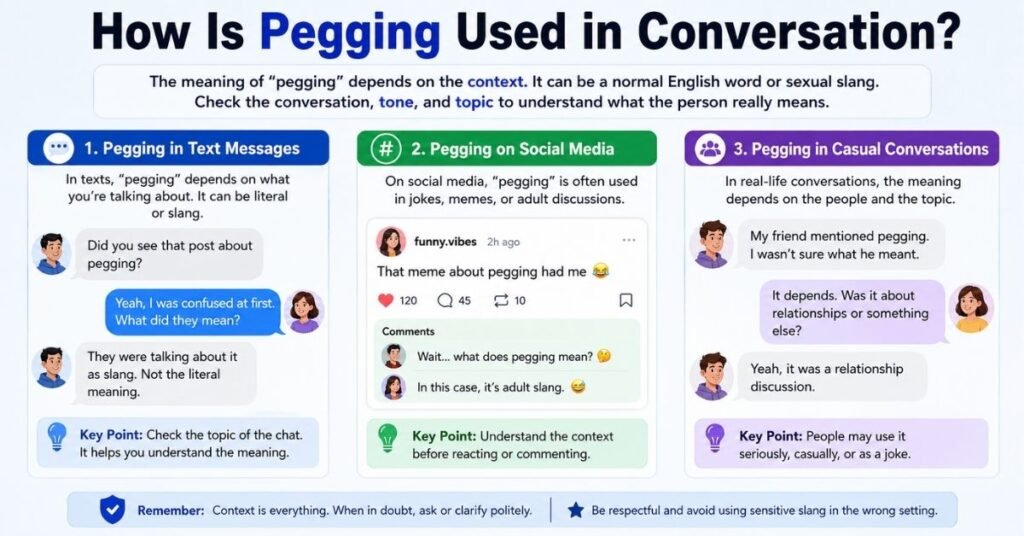
People use the word differently depending on whether they’re discussing ordinary English, slang, dating, or internet culture.
If you’re learning how pegging is used, look at the words around it rather than assuming one meaning every time.
Pegging in Text Messages
In texting slang, “pegging” is usually understood from the conversation around it. A message about relationships may use the adult slang meaning, while a message about practical work may use the literal meaning.
Tone also matters. Friends may use the word jokingly, while a serious conversation may use it literally.
- “That post mentioned pegging again.”
- “I had to look up pegging.”
- “They were joking about pegging.”
- “What does pegging mean here?”
- “That text uses pegging as slang.”
- “I didn’t know the meaning of pegging.”
- “The conversation suddenly turned to pegging.”
- “Context makes the pegging reference clearer.”
- “She asked what pegging meant in the message.”
- “I thought pegging had only one meaning at first.”
Pegging on Social Media
On social media, pegging meaning on social media can shift quickly because users often use words as jokes, references, or memes.
TikTok, X, Reddit, and other platforms can expose people to slang they haven’t encountered before. A post may also intentionally leave the meaning ambiguous to make a joke work.
- “I saw pegging mentioned in a meme.”
- “TikTok comments can make pegging confusing.”
- “The post used pegging as a joke.”
- “Someone asked about the slang meaning.”
- “The comment section changed the context.”
- “I searched for pegging after seeing that post.”
- “The meme wasn’t using the literal meaning.”
- “Social media spreads unusual slang quickly.”
- “That caption made the meaning obvious.”
- “The word appeared in a dating discussion.”
Pegging in Casual Conversations
In everyday conversation, the meaning depends on the subject. Someone talking about camping or household tasks could use “pegging” literally.
In a conversation about adult relationships, the slang meaning may be intended instead. When unsure, consider the surrounding topic before interpreting the word.
- “The meaning depends on the conversation.”
- “They were discussing relationship slang.”
- “He used pegging in a casual joke.”
- “The context made the reference clear.”
- “She asked what the slang meant.”
- “That wasn’t the literal meaning.”
- “The conversation was about internet slang.”
- “They weren’t discussing camping or construction.”
- “I understood the word from context.”
- “The meaning changed with the topic.”
Pegging Example Sentences
Seeing pegging examples can make the difference between recognizing a word and actually understanding it.
The following sentences use the term in different contexts. Some are neutral, while others show how the slang meaning may appear online.
Neutral Examples of Pegging
These examples use “pegging” in ordinary English contexts rather than sexual slang.
- “They were pegging the fabric to the line.”
- “The workers finished pegging the tent down.”
- “She was pegging the clothes outside.”
- “The map was pegging the location incorrectly.”
- “The currency remains pegged to another currency.”
- “He spent the afternoon pegging everything securely.”
- “The tent needs pegging before the wind picks up.”
- “They discussed pegging the price to inflation.”
- “The fabric stayed in place after pegging.”
- “The system uses a fixed currency peg.”
Slang Examples of Pegging
In these examples, “pegging” carries its adult slang meaning. The sentences remain non-graphic while showing how the term can appear naturally.
- “They were discussing pegging in a relationship.”
- “That dating podcast mentioned pegging.”
- “She asked about the slang term pegging.”
- “The conversation involved adult relationship preferences.”
- “The joke was clearly about sexual slang.”
- “He encountered the term while reading dating advice.”
- “The post used pegging as an adult reference.”
- “They explained the term without going into detail.”
- “The slang appeared in a relationship discussion.”
- “The comment used pegging in its modern adult sense.”
How Context Changes the Meaning
The same word can point to completely different ideas. “Pegging a tent” is practical, while “pegging” in an adult relationship discussion has a sexual meaning.
That contrast shows why the literal vs slang meaning matters. Never interpret a slang term from the word alone.
Is Pegging Considered a Sensitive or Offensive Word?
“Pegging” isn’t automatically an offensive word, but its sexual meaning makes it sensitive in many settings. The word may be fine in an adult relationship discussion but inappropriate in a classroom, workplace, or family conversation.
The safest approach is to consider your audience before using the term.
When the Term May Be Inappropriate
- Avoid sexual slang in professional conversations.
- Consider whether children may be part of the audience.
- Don’t assume everyone knows the adult definition.
- Use neutral language when discussing the term formally.
- Think about the setting before making jokes about it.
Situations Where You Should Avoid Using It
- Workplace meetings
- School assignments for younger audiences
- Professional presentations
- Formal customer communication
- Conversations where sexual topics aren’t appropriate
Understanding the Meaning Without Misusing the Term
You don’t need to use a slang word simply because you understand it. Knowing the pegging terminology helps you interpret posts, messages, and conversations accurately.
If you need to discuss the term in a formal setting, describing it as an adult sexual slang term is usually clearer and less awkward.
Pegging vs. Related English and Slang Terms
“Pegging” can be confused with other forms of “peg” or unrelated relationship slang. Comparing the terms makes the distinctions easier to remember.
Pegging vs. Peg
| Term | Meaning/Context |
| Peg | A small object used for fastening or support |
| Peg | To fix, attach, or secure something |
| Pegged | Fixed, classified, or linked to something |
| Pegging | The act of using a peg or fixing something |
| Pegging | An adult sexual slang term in certain contexts |
Pegging vs. Similar Relationship Slang
| Term | Meaning/Context |
| Pegging | Adult sexual relationship slang |
| Hooking up | Informal term for a sexual or romantic encounter |
| Making out | Kissing or romantic physical affection |
| Intimacy | Emotional or physical closeness |
| Bedroom slang | Informal vocabulary about adult sexual activity |
Related Internet and Sexual Slang Terms
- NSFW — Content considered unsuitable for workplaces or public settings.
- Hookup — Casual sexual or romantic encounter.
- Situationship — A relationship that doesn’t have a clearly defined status.
- FWB — “Friends with benefits,” describing friends who also have a sexual relationship.
- Thirst trap — Content designed to attract attention through sexual or attractive presentation.
- NSFL — A stronger warning for content considered especially disturbing or unsuitable.
- Adult slang — Informal vocabulary used when discussing sexual or mature subjects.
Why Is Pegging Commonly Mentioned Online?
The internet gives unusual slang terms a much bigger audience. A word that once appeared mostly in adult conversations can now show up in memes, podcasts, comments, dating discussions, and viral posts.
That’s why pegging in internet culture may look more common than it actually is in ordinary face-to-face speech.
Pegging in Internet Humor
Internet humor often relies on surprise and context. A creator may mention a sensitive term because the unexpected reference makes a joke funnier.
That doesn’t mean every online use is a serious discussion of the activity. Sometimes the word is simply being used for shock value or as part of a meme.
Pegging in Pop Culture and Media
The term has appeared in entertainment, comedy, podcasts, relationship discussions, and other forms of adult-oriented media.
Its appearance in popular culture has helped make the word more recognizable. Still, recognition doesn’t mean everyone uses or understands it in exactly the same way.
Why Slang Terms Spread on Social Media
Social platforms make language move quickly. A phrase can jump from one community to another through memes, reposts, short videos, comments, and influencer content.
Popular slang terms often become familiar long before users know their original meaning. That’s one reason searches for definitions remain common.
Common Mistakes When Using the Word Pegging
The biggest mistake is assuming that “pegging” always has the adult slang meaning. English has several ordinary uses of “peg,” and context determines which one applies.
Another mistake is treating every online reference as serious. Internet users often exaggerate or joke with sensitive terminology.
Confusing Literal and Slang Meanings
- Check the subject of the conversation first.
- Look at nearby words for clues.
- Remember that “peg” has ordinary English meanings.
- Don’t assume every social-media reference is literal.
- Consider whether the conversation is about adults or everyday activities.
Using the Term Without Considering Context
- Avoid sexual slang in formal settings.
- Think about who will read or hear the phrase.
- Don’t use sensitive slang simply for shock value.
- Explain the term if your audience may misunderstand it.
- Choose clearer wording when discussing the topic professionally.
Frequently Asked Questions
What does pegging mean in English?
The pegging meaning in English depends on context. It can refer to fastening or fixing something, while modern slang commonly uses it for an adult sexual practice.
What does pegging mean in slang?
In modern sexual slang, pegging refers to a consensual adult sexual practice involving a strap-on. Online, the word may also appear casually as a joke or meme reference.
What’s the meaning of “I’ll peg you”?
“I’ll peg you” is usually a sexual slang phrase referring to pegging, where one partner uses a strap-on during sex. Its meaning depends on the context and relationship.
What is the pegging process?
Pegging generally refers to a sexual activity involving one partner penetrating the other with a strap-on. It is an adult sexual term and can describe consensual activity between partners.
What does “pegged out” mean in slang?
Pegged out” is usually not the same as sexual pegging. In slang, it can mean being completely exhausted, worn out, or unable to continue.
What does pegging mean in a romantic context?
In a romantic context, pegging usually refers to a consensual sexual practice between partners. It may be discussed as part of intimacy, sexual preferences, or relationship communication.
Final Thoughts
Understanding pegging meaning in English comes down to one simple rule: always check the context. The word can describe an ordinary action involving a peg, a figurative connection, or an adult sexual practice.
If you encountered it on TikTok, in a text, or in an online conversation, don’t assume the first definition you find is automatically correct. Look at the surrounding words, identify the context, and you’ll usually know what the speaker intended.

Arslan Rafi is a writer and language enthusiast who creates easy-to-understand content about slang, expressions, words, and their meanings. His work focuses on explaining regional and modern language in a clear, engaging way, helping readers understand how words and phrases are used in everyday conversation.