BD268XZ Explained: Ultimate Guide to Meaning, Uses, and Benefits (2026)
You spot a strange code in a log file. It reads BD268XZ. You pause and wonder what it means. People meet odd codes like this on product labels, in vendor emails and inside software dashboards. This guide gives you BD268XZ explained in plain words. You will learn the BD268XZ meaning, the possible BD268XZ uses and the real limits of the term.
Here is the catch. No official source confirms what BD268XZ is. Many pages online invent features for it. This article takes a different path. It separates proven technical ideas from guesses. By the end you will know how to verify the origin of BD268XZ before you trust it.
What Is BD268XZ? Meaning and Purpose
What is BD268XZ? It is an alphanumeric identifier built from letters and numbers. Two letters come first. Three digits follow. Two more letters close the string. This pattern is common in any technical reference code scheme. The pattern alone reveals nothing about the owner. Think of a locker number. It means little until you know the building.
What does BD268XZ mean? The BD268XZ meaning depends on where you found it. It might label a product or act as a database identification number. It could also serve as a tracking tag or an internal note. These are possibilities and not proven facts. This guide treats the BD268XZ code as a unique identification code example. That approach keeps every claim honest.
How Does BD268XZ Work in Digital Systems?
How does BD268XZ work? No public specification answers that directly. We can still explain how digital identifiers work in general. A system picks a code and attaches it to a record. It then stores that link in a database. Other programs use the code to find the record again. This is the core idea behind BD268XZ digital systems and many others.
The process has four stages. Each stage solves one problem. The table below shows them at a glance.
| Stage | Question it answers | Example |
| Define | What format is allowed? | Two letters, three digits, two letters |
| Assign | Who creates the code? | An app or a database |
| Link | Which data does it point to? | An order or a device |
| Store and update | Where does the record live? | A relational database |
Understanding the Structure of BD268XZ
Structure comes first in any digital identification system. Designers set the allowed characters and the length. They also pick the capitalization rules. The string BD268XZ has seven characters. It uses capital letters and digits only. A clear format makes identifier validation easy. A program can reject any value that breaks the pattern. Understanding alphanumeric codes starts with these simple rules. Good teams write the rules down in their software documentation.
How Unique Identifiers Are Generated and Assigned
Identifier generation can happen in three ways. An application can create the code. A database can create it. An administrator can also assign it by hand. The big danger is a collision. A collision happens when two records get the same code. Large systems often use a standard such as the UUID format. You can read it in RFC 9562. A short code like BD268XZ is not safe by itself. The issuing system must guarantee duplicate record prevention.
Linking BD268XZ to Relevant Data
A code works like a pointer. It does not hold the data. It simply leads you to the data. Picture an order number on a shipping label. The number is short. The order behind it holds items, prices and addresses. This is BD268XZ data management in its simplest form. The BD268XZ system reference stays stable while other details change. A customer can change an address and the order number stays put.
Storing, Managing, and Updating Records
Records need a safe home. Relational databases such as PostgreSQL can enforce a unique rule on a column. The PostgreSQL documentation on unique indexes explains how this works. Teams also add backups and audit logs. Each change then leaves a trail. This supports digital record tracking and data integrity. Strong information management needs these habits from the start.
Key Applications of BD268XZ in Technology
Common uses of technical identifiers span many fields. Stores use them for products. Hospitals use them for lab samples. Software teams use them for tickets and events. These are general facts. They are not confirmed BD268XZ applications. Keep that line clear as you read.
The next five sections cover the possible applications of BD268XZ. Each one shows where a code of this type could fit. Real fit depends on the system and its needs. Always check the documentation first.
BD268XZ in Database Management Systems
In a database an identifier often becomes a primary key. A database key like this makes each row easy to find. Other tables can then refer to it through a foreign key. That link builds relationships between customers and orders. BD268XZ and database systems can work together if the format fits the rules. Teams should pick the right data type early. They should also decide whether the code must stay fixed forever.
BD268XZ in APIs and Backend Development
An API reference often places an identifier in a web address. A request might ask for item BD268XZ. The server then returns the matching record. Backend systems must validate every incoming value. They must also check the caller’s permission. A guessable code invites snooping. The OWASP guide to broken object level authorization explains this risk well. Good system interoperability needs clear and shared rules.
BD268XZ in Cybersecurity and Access Management
Security tools use identifiers for accounts and devices. They also use them for alerts. A code helps an analyst trace one event across many logs. Yet identification is not login. Knowing a code must never open a door. Strong access control relies on verified credentials and least privilege. Cybersecurity teams treat a code as a label. They never treat it as a secret.
BD268XZ in Cloud Computing and Distributed Systems
Cloud computing creates huge numbers of short-lived resources. Servers, files and jobs all need names. Distributed databases spread records across many machines. A shared code lets each machine talk about the same item. Teams must also keep codes consistent across development, testing and live systems. Otherwise mapping errors creep in. Good data retrieval depends on that consistency.
BD268XZ in AI and Automation Workflows
AI pipelines handle data from many sources. An identifier links each input to its output and its log. Automation tools also use codes to trigger tasks. Still, the name BD268XZ implies no AI function. Nobody should claim it powers a model without proof. Real documentation and measured results must back any such claim.
BD268XZ vs. Sequential IDs: Key Differences
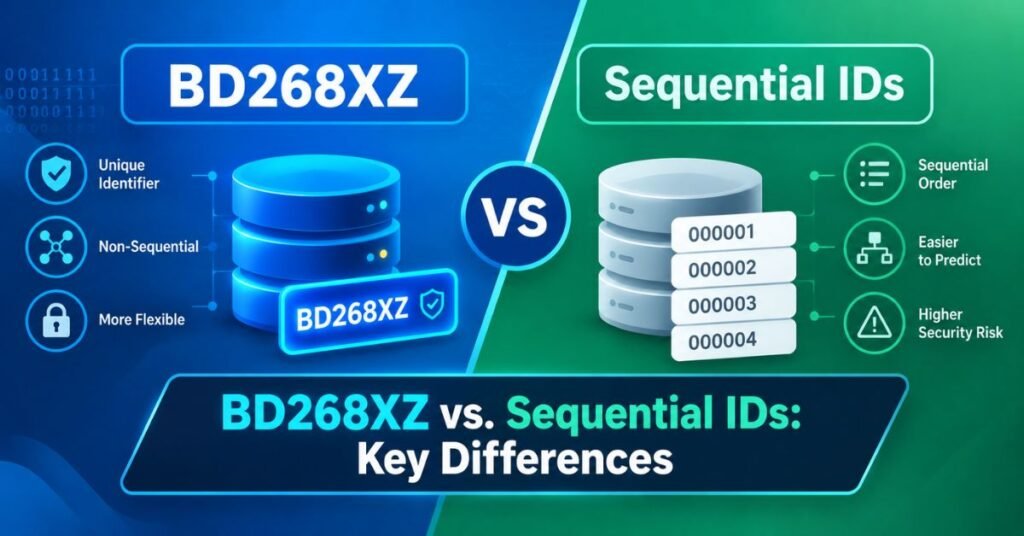
BD268XZ compared with sequential IDs shows two design styles. A ticket counter hands out 1 then 2 then 3. That is a sequential number. A coded string like BD268XZ follows custom rules instead. It can mix letters and digits. It can also hint at a category.
Neither style wins every time. Sequential numbers are simple and fast to create. Coded strings offer more flexibility but need more care. This is also BD268XZ compared with traditional identification codes. The table sums up the main contrasts.
| Factor | BD268XZ-style code | Sequential ID |
| Format | Letters and digits | Digits only |
| Predictability | Depends on the method | Very high |
| Creation effort | Needs rules and checks | Simple auto-increment |
| Readability | Can carry category hints | Plain and short |
Identifier Structure and Uniqueness
Is BD268XZ a unique identifier? Only its issuing system can guarantee that. A sequential counter is unique inside one database by design. A coded string needs extra checks. Uniqueness also has a scope. A code may be unique in one app but repeat in another. Always ask where the guarantee applies. A unique identifier (UID) is only as strong as its rules.
Data Organization and Retrieval
Both styles support data indexing. Numbers are compact and sort in a natural order. Strings take more space and sort in text order. That difference can change data retrieval speed in large tables. Coded strings do bring one gain. They can group items by prefix. These data organization methods help teams filter records quickly. Testing with real queries gives the final answer.
Security and Privacy Considerations
Sequential numbers are easy to guess. An attacker can try 101 then 102 then 103. That tactic is called enumeration. A coded string can slow it down. Yet a code is not magic armor. Security considerations for digital codes still demand permission checks on every request. Never place personal details inside an identifier. Logs and web addresses may expose it.
What Are the Main Benefits of BD268XZ?
The BD268XZ benefits below are conditional. They appear only when a team designs and runs the system well. A badly planned code gives no gain. Treat each benefit as a goal and not a promise.
Teams that manage many records across several apps gain the most. Small projects may need nothing more than a simple counter. The sections that follow show where a good identifier management system pays off.
See Also: Free AI Presentation Maker: Create Slides with AI
Improved Data Organization and Tracking
A stable code gives every record a fixed name. People can rename products and nothing breaks. Reports, tables and apps all point to the same reference. This makes record identification faster and cleaner. It also supports digital record tracking across tools. Clear naming rules cut confusion between similar items. The gain comes from good design and not from the characters themselves.
Scalability for Growing Digital Systems
Growth tests every identifier. A format that works for one thousand records may fail at ten million. Planners should choose a generation method that scales. They should also define the uniqueness scope early. BD268XZ technology, if it exists as a scheme, would need the same planning. Load tests reveal weak spots before customers do. Future integrations also deserve a place in the plan.
Better Record Traceability and Management
Data traceability means you can follow a record from birth to archive. Identifiers make that journey visible. Pair each code with timestamps and a status field. Add an audit log and the story becomes complete. Here is a short case study. Imagine a small online shop that tags each order with a code. A customer reports a missing parcel. Staff search the code and see every step in seconds. The code alone did not solve it. The logs behind it did.
Potential Efficiency and Performance Benefits
An indexed lookup can find one record without scanning every row. That saves time in big tables. However, speed also depends on hardware and network delay. Query design matters too. Measure before you boast. Run a benchmark on the full system. Then decide whether BD268XZ uses really improve performance or reduce cost.
What Are the Challenges of Using BD268XZ?
Nothing in technology comes free. A new identifier brings new work. Teams must plan format rules, tools and training. They must also keep the plan alive as systems change.
Here is a helpful rule of thumb.
Treat every new identifier as a small product. Give it an owner, a written spec and a test plan.
A pilot rollout reveals trouble early. Start small. Fix what breaks. Then expand.
Technical Setup and Implementation Complexity
A code looks simple but touches many parts. Developers must write generation rules and validation checks. They must handle errors and name an owner for the format. APIs, reports and internal guides may all need updates. This is where BD268XZ technical details matter. Without a written spec every team invents its own version. A short pilot shows the hidden costs.
Database Indexing and Storage Requirements
Strings use more space than plain numbers. Indexes add more. Each index also slows writes a little. A fixed-length text field may suit a stable code like BD268XZ. Other designs may fit different needs. Test real queries before you commit. Balance lookup speed against storage cost and upkeep.
Compatibility With Existing Systems
Older software often expects numeric keys. It may also cap field length. A new alphanumeric code can break those assumptions. Check schemas, API contracts and import tools before launch. Review third-party links too. A mapping layer can bridge old and new formats. That layer eases the move toward shared system interoperability.
Duplicate Identifiers and Data Integrity Risks
Duplicates cause real damage. Two records can merge or one can overwrite the other. The risk grows when separate systems create codes on their own. Database constraints stop most clashes. Collision checks add a second guard. Data integrity and identifier management go hand in hand. Plan how you will detect, report and fix any duplicate that slips through.
How to Generate and Manage an Identifier Like BD268XZ
How to manage unique identifiers is a skill you can learn. The steps below work for product codes, order numbers and device tags. They also apply to any unique identification code you design.
Write each decision down early. Review it as needs change. A short document saves months of confusion later.
See Also: 20xBusiness.com: Business Growth, Finance, and Digital Marketing Guides for Owners Worldwide
Choose a Consistent Identifier Format
Set the length and the allowed characters. Decide on capital or small letters. Add a check rule so every app enforces the same pattern. Never change the format without a migration plan. Old records and new records must still match. Consistency prevents errors in imports, API calls and lookups.
Configure Database Indexing
Index the fields that people search most. Do not index everything by habit. A unique index suits a code used for single-record lookups. Review query plans on a regular basis. Watch how indexes affect insert speed. The best setup depends on your engine and your record volume.
Prevent Duplicate Records
Use a trusted generation method. Enforce uniqueness inside the database itself. App checks give quick feedback but a database rule is the final guard. Systems with many servers need a method built for that setting. Test collision handling before launch. Good duplicate record prevention protects every report built on the data.
Apply Appropriate Security Controls
Difference between an identifier and a security token: an identifier names a thing while a token proves a right to act. An authentication token must stay secret and expire. A code like BD268XZ should never play that role. Require login and permission checks on protected actions. Keep personal data out of the string. Protect your digital identity systems with layers and not with one clever code.
Monitor Performance and Data Accuracy
Track lookup times and failed requests. Count duplicate-key errors. Watch database load after each release. Set alerts for odd spikes. These signals help you tell identifier problems from network or code problems. Regular reviews keep the identifier management system healthy.
Is BD268XZ Secure and Reliable?
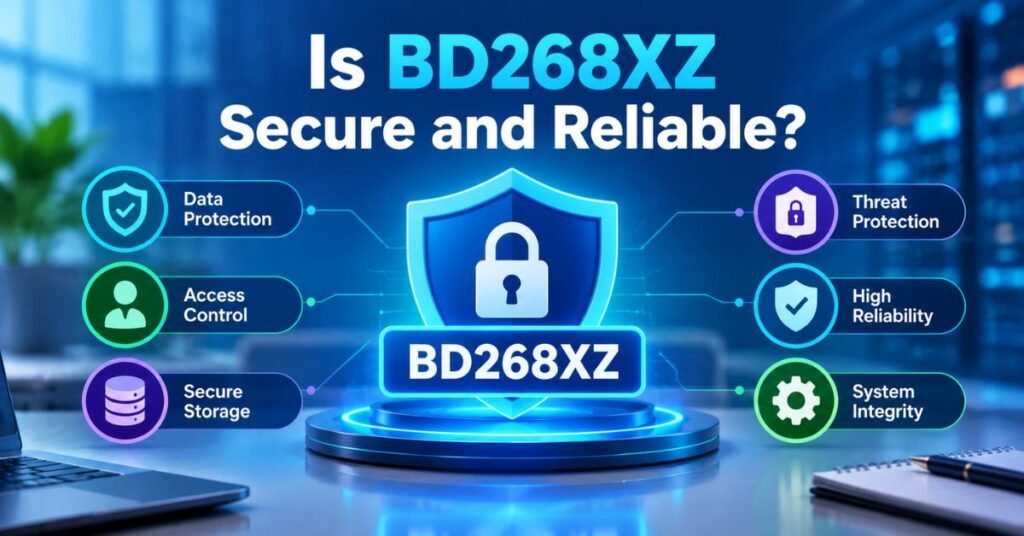
The code alone cannot be called safe or unsafe. Security comes from the system around it. That system creates, stores, sends and checks the code. Weak handling can ruin even a random-looking string.
Judge the setup and not the appearance. Look at the controls, the tests and the documentation. The three sections below show how.
Data Protection and Access Control
Reliable systems pair clean identifiers with strong protection. Role-based access limits who sees each record. Encryption guards data in storage and in transit. Secure backups prepare you for failure. Audit logs show who did what. When records hold personal data follow the privacy laws that apply to you.
Common Security Risks and Limitations
Watch for guessable codes and open logs. Weak validation lets bad input through. Mismatched records can leak data to the wrong person. Even a random code fails when permissions are missing. Review where the code appears. Ask what a stranger could learn by submitting it. These checks answer most security considerations for digital codes.
How to Verify an Implementation’s Reliability
Start with the source. Find the team or vendor behind the code. Read the official guides, the version history and the security notes. For an internal system review the source code and the database rules. Study test results and access policies. Critical systems deserve independent security testing. If no trusted source explains the code do not call it verified.
Is BD268XZ a Verified Technology Standard?
Is BD268XZ a real technology? The code itself is real text. But no authoritative source shows it as a product or a protocol. Is BD268XZ an official technical standard? Current evidence says no. Search results and blog posts do not count as proof. Only a standards body or a documented specification can confirm it.
That is why Is BD268XZ a recognized technology standard? is a smart question to ask. Standards groups publish their work openly. Vendors publish product guides. If neither lists BD268XZ treat it as an unverified label. This stance protects your budget and your reputation.
See Also: Client Case Aelftech Com: 7 Powerful SEO Strategies and Results (2026)
How to Check the Origin and Technical Documentation
How to verify the origin of BD268XZ begins with a search of vendor sites. Check code repositories next. Then look at standards organizations. Ask the person who gave you the code where it came from. How to identify an unknown technical code works the same way. Trace it to its source. Read the technical specifications. If you find none keep your doubt.
Distinguishing a Technical Identifier From a Software Product
Is BD268XZ a software tool, code or technical identifier? Use a quick test. A real product has a version history and an installer. It also has an API reference and support pages. An identifier has none of those. It is just a label. How to identify the BD268XZ code as a label comes down to missing product evidence.
What to Verify Before Using BD268XZ
Check four things before you rely on any unfamiliar code. The table lists them.
| Check | Question to ask |
| Source | Who issued the code? |
| Purpose | What does it represent? |
| Scope | Where is it unique? |
| Security | Does the owner publish guidance? |
How to verify whether BD268XZ is legitimate follows from these answers. Missing answers mean you should wait.
The Future of Identifier Systems Like BD268XZ
Nobody can verify future claims about BD268XZ itself. Anyone who promises a bright path is guessing. Identifier management as a field is another story. It keeps growing as data grows.
Four trends stand out. Each one shows why reliable codes matter. None of them proves a role for BD268XZ.
Potential Uses in Cloud Computing
Cloud platforms track servers, storage and jobs by reference. Teams need clear rules for each reference. Standard interfaces help tools work together. A code like BD268XZ could serve as an internal tag if its lifecycle fits the platform. That use remains a possibility and not a fact.
AI-Driven Data Management and Automation
AI tools label data and log each step. Identifiers tie those logs to the right records. This helps teams find and fix errors. Claims that a code boosts model quality need measured proof. Until then, BD268XZ in digital data management stays an open question.
Possible Integration With Blockchain Systems
Blockchains use transaction IDs and wallet addresses. An outside code could point to a chain record. Yet a code does not create cryptographic safety. It does not make data unchangeable either. Those traits come from the protocol itself. Never confuse a label with a guarantee.
Identifier Management in Internet of Things (IoT) Devices
Sensors and smart machines send constant data. Each device needs a unique reference. Platforms use it to match readings and repair history. A code such as BD268XZ might fit a device scheme if it stays unique for the device’s whole life. Without proof that use is only an idea.
Why Should Businesses Understand BD268XZ?
Imagine buying software because of an unverified term. The mistake costs money and time. Leaders who ask simple questions avoid that trap. How businesses use unique identification codes shows why this matters. Orders, assets and customers all depend on clean references.
Here is a short action plan. Ask vendors for documents, known limits and proof of compatibility. Check the benefits and limitations of digital identifiers against your own needs. Count maintenance costs and retention rules. Then decide. This habit also reduces the security risks associated with digital identifiers.
Common Misconceptions About BD268XZ
Unfamiliar codes attract wild guesses. Online posts repeat those guesses until they sound true. Facts need to come first.
Three myths appear most often. The sections below answer each one with plain evidence.
Is BD268XZ Just a Random Code?
It may look random. Looks tell you nothing about its origin. Some codes follow strict rules while others come from internal tools. Without documents nobody can say which type BD268XZ is. So the safest answer is “unknown.”
Does BD268XZ Have Practical Applications?
Alphanumeric identifiers do have practical uses. Databases, APIs and asset tracking all rely on them. Those uses belong to the whole category. They do not prove a specific use for BD268XZ. Find its source first and then judge its value.
Is BD268XZ Difficult to Implement?
A short code is easy to store and check. The trouble grows with scale. Legacy software and strict security add more work. Distributed creation of codes adds risk too. A clear spec and solid tests keep the effort manageable.
Frequently Asked Questions
These quick answers target the questions people ask most. Each one stays short and direct. They also support BD268XZ code explained for beginners and BD268XZ meaning and possible uses.
Use them as a fast reference. Return to the longer sections when you need detail. Remember that every answer reflects the evidence available today.
What Does BD268XZ Mean?
The BD268XZ meaning has no confirmed answer. It is an alphanumeric string. Its definition depends on the system or source where you found it. What BD268XZ means in digital systems can only be learned from that source’s own documents.
What Is BD268XZ Used For?
No confirmed use exists. Similar codes label products, records, transactions and devices. Do not assign any of those roles to BD268XZ without proof. Learn the possible applications of the BD268XZ identifier from its owner.
Is BD268XZ a Software Tool, Code, or Technical Identifier?
The term alone does not settle it. It may be a code or an internal label. It may even be a product name. Official documents or its creator can classify it. Without them call it an unverified alphanumeric code.
Can BD268XZ Be Used in Database Systems?
Yes, a string like it can work as a database key. The system must support the format. Add validation rules and a unique constraint. Index it based on real queries. How alphanumeric identifiers work in databases depends on these settings.
Is BD268XZ an Official or Verified Technology Standard?
Not based on current evidence. No standards body or specification confirms it. Check standards groups and vendor documents before you accept any claim. Until then treat BD268XZ as an unverified term.
Conclusion:
BD268XZ explained comes down to one honest idea. It is an alphanumeric string with an unconfirmed origin. General identifier rules still teach useful lessons. Good format design, duplicate prevention, smart indexing and strong access control protect any record system. They matter far more than the look of a code.
Your next step is simple. Verify the source first. Then test a small pilot before wider use. Keep BD268XZ technology claims tied to evidence. Do that and you will make safer choices with BD268XZ or any code like it.

Arslan Rafi is a writer and language enthusiast who creates easy-to-understand content about slang, expressions, words, and their meanings. His work focuses on explaining regional and modern language in a clear, engaging way, helping readers understand how words and phrases are used in everyday conversation.