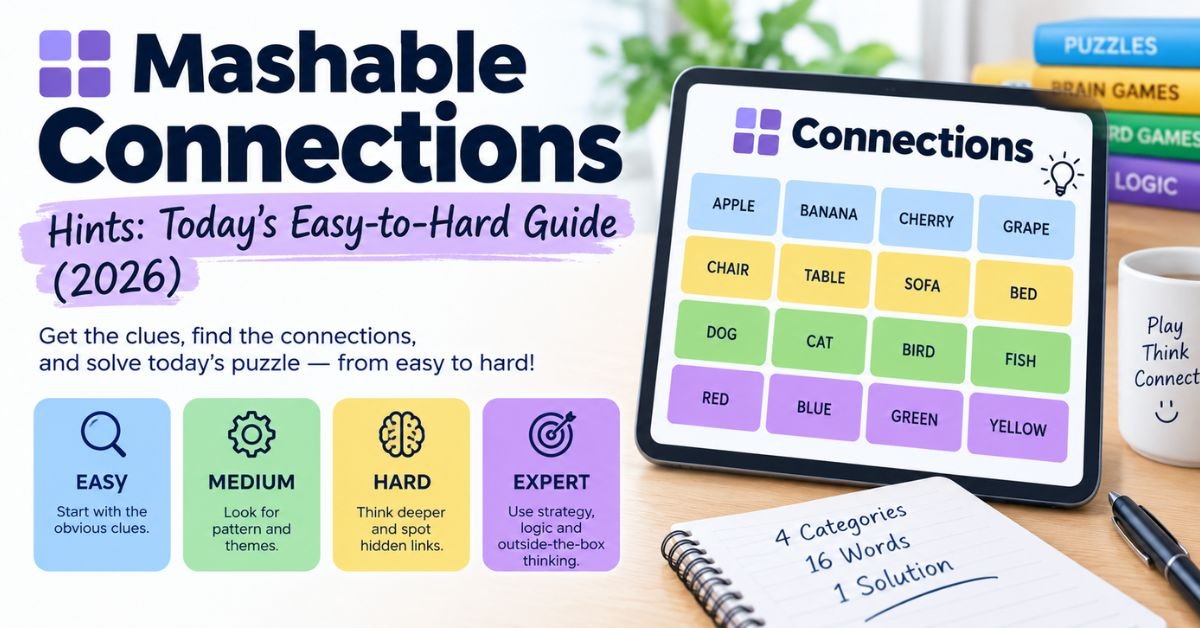
Mashable Connections Hints: Today’s Easy-to-Hard Guide (2026)
One mistake left. Four words are selected and your finger hovers over Submit. Does that moment feel familiar? Every fan of the Connections word game has lived it. The Mashable Connections puzzle looks easy at first glance. Sixteen words sit on the screen and each one seems to fit everywhere. That’s the trap.
The easy to hard Mashable Connections hints below arrive in gentle layers. You get a soft nudge first and a firmer clue next. The full answers wait at the end for the moment you truly need them. Puzzle #1217 from Saturday, October 10, 2026 serves as the worked example.
Why bother with layers? Because a good hint keeps the fun alive. A full answer list ends the game in seconds. A small clue lets you finish the daily Connections puzzle with your own brain. Along the way you’ll pick up Connections solving tips that work on any board.
Beginners and long-time streak keepers both gain something here. Expect plain English and short steps. Expect a few tables and a few real-world examples too. A spoiler warning will appear well before any answer shows up. So take a breath and start with the basics.
What Are Mashable Connections Hints?
Think of a hint as a flashlight in a dark room. It doesn’t carry you across the floor. It just shows where the furniture sits. Mashable Connections hints work the same way. They describe a category without naming its four words. They serve the daily word association puzzle that the New York Times publishes every morning. A good set of Mashable daily puzzle hints moves from vague to precise. First comes a theme. Then comes a narrower clue. Finally comes the full solution. You choose how far up the ladder to climb. That choice is what makes hints feel fair.
Read More: DreamMeaniing.com USA Review 2026: Is It Safe, Legit, and Worth Using?
Who uses them? Almost everyone. Beginners lean on Connections puzzle hints to learn how categories work. Veterans use them to save a long streak. Casual players check them when one group refuses to budge. The best pages also offer hints without answers so nothing gets ruined by accident.
That matters because the board resets each day. Yesterday’s answer is useless today. Always match the page date to your puzzle number. Every Mashable Connections game hint you read should fit the board on your screen. A mismatch wastes time and can even spoil the wrong day.
How the Mashable Connections Puzzle Works
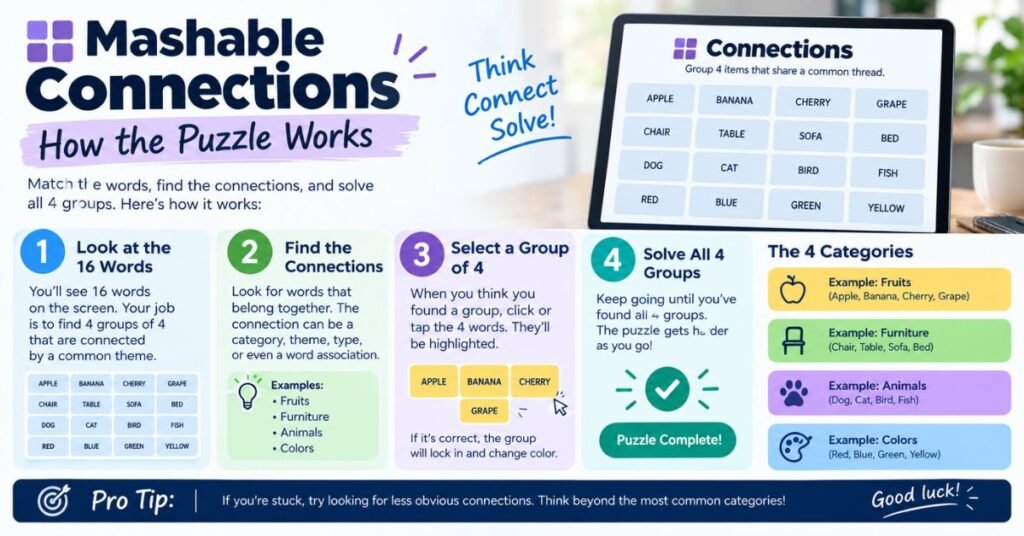
Picture sorting sixteen mixed socks into four drawers. That’s the whole idea. The Connections game rules are short. Sixteen words appear on a grid. You pick four that share a link and press Submit. A right guess reveals the category and locks the row. A wrong guess costs one life. You get four mistakes in total. After the fourth miss the game ends and shows the answers. The New York Times runs the game and you can play it on the official NYT Connections page. Since its launch in June 2023 it has become a daily habit for millions of players worldwide.
Colors rank the difficulty. The four color-coded categories run from yellow to purple. Yellow is usually the friendliest and green comes next. Blue asks for more thought. Purple often hides a trick.
These Connections color categories help you plan your attack. The yellow green blue purple groups each hold four-word Connections groups with one shared rule. That rule might be a topic or a meaning or a phrase pattern. The table below gives a quick summary. Remember that color shows the setter’s expected difficulty. Your own experience may differ.
| Color | Usual difficulty | Typical rule type | Example of the style |
| Yellow | Easiest | Common topic or activity | Things used for a school task |
| Green | Moderate | Shared meaning | Words that mean “assume” |
| Blue | Harder | Specific setting | Parts of a phone app |
| Purple | Hardest | Wordplay or hidden pattern | Words that join one shared partner |
Mashable Connections Hint Today: Start With Gentle Clues
Always begin with a topic and not a word. One firm topic shrinks the whole board. Below you’ll find the today’s Connections clues for puzzle #1217. Each one is a Connections game clue that names a theme only. None of them lists an answer word. Two words on this board live double lives.
One can mean a number or a shape or a hunch. Another can mean dinner for a pet or a stream of posts. Hold both loosely. Let the cleaner groups claim their words first. That habit alone saves many mistakes. These Mashable Connections hints today for beginners keep the spoilers away.
| Color | Gentle clue |
| Yellow | Think about what you’d prepare or produce while working on a school paper. |
| Green | Each word can mean you assume something, as in “I ___ you’re right.” |
| Blue | Picture opening a social app on your phone. Which sections would you tap? |
| Purple | Each answer can sit in front of the same word. Think ring and gloves. |
Read each clue and then glance at the board. Do any words jump out? Great. Test two or three of them against the clue. Don’t submit yet. A hunch is not a rule. Say the category aloud in a short phrase. If the phrase sounds sloppy the group probably is too. This is the heart of category identification. It trains your logical reasoning one small step at a time. Beginners often skip it. Strong solvers never do. A few seconds spent here can save a life later. Those lives are precious on a tricky day.
How to Use the First Hint Without Revealing the Answer
Read the clue once and then look away from the page. That’s the secret. Give yourself two minutes with the board. Try to match each clue with a few words. Hold the match in your head or jot it on paper. Only then scroll for the next layer. This is how to use Mashable Connections hints without spoiling the fun. Think of a kitchen timer. You peek only when it rings. Many readers allow one hint per color. Others allow one hint per mistake. Pick a rule and stick to it. These Mashable Connections hints without revealing answers protect both your streak and your pride.
Read More: 25:Best Ensalada de Garbanzos Near Me: Where to Find Fresh, Authentic Chickpea Salad
Stronger Hints for Difficult Connections Groups
Still stuck? Stronger hints tighten the net. They describe how a word behaves and not just what it means. These Connections puzzle hints still avoid the answers. They use roles and senses and sample phrases. A clue might say that a word fits the pattern “I ___ you’re right.” That points to a sense without naming the word. Try one clue at a time. Solve a group and then reread what remains. Every solved row clears away distractions. The remaining choices often look far clearer after a single win. This is the easiest way to learn how to solve Mashable Connections on harder days.
| Color | Stronger hint |
| Yellow | All four words belong to the planning and writing stages of an essay, from an early version to the central claim. |
| Green | Four verbs fit the “I ___ you’re right” pattern. One of them also names a number or a shape. |
| Blue | One section shows posts. Another holds private chats. A third pings you about activity. The last describes you. |
| Purple | The shared word comes after each answer. One answer means mouth-made drum sounds. Another means opening a package. |
Why not give the words directly? Because the lightbulb moment is the best part. Mark Twain once wrote that the gap between the almost right word and the right word is large. In an 1888 letter he described it as the difference between “the lightning-bug and the lightning.” A game full of tricky Connections categories lives in that gap. Your job is to find the exact word sense and not a near match. Stronger hints push you toward that sense. Use them kindly and sparingly. The reward is a clean click and a satisfying color reveal.
Mashable Connections Categories Explained
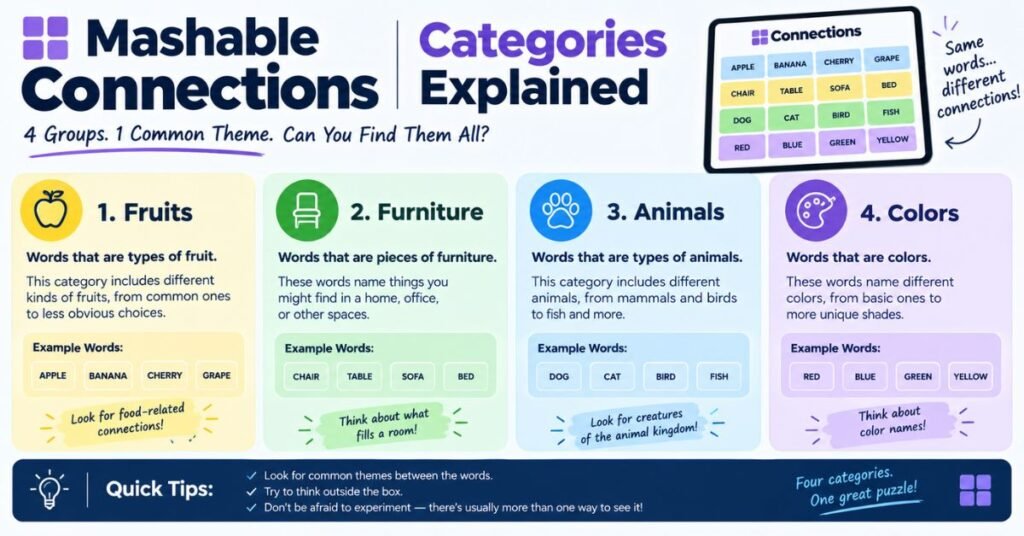
Spoiler warning. Every answer appears below this line. If you still want to solve the board yourself then scroll back up and reread the hints. Ready? Here are the Mashable Connections answers for puzzle #1217 in order of difficulty. The table lists each color and its category and its four words. After the table each color gets a short note. These notes explain why the words belong together. Knowing the why matters more than knowing the what. It builds skill for tomorrow’s board. The sixteen starting words match the grid posted by Technobezz.
| Color | Category | Words |
| Yellow | Useful when writing a paper | DRAFT, NOTES, OUTLINE, THESIS |
| Green | Presume | FIGURE, GATHER, IMAGINE, SUPPOSE |
| Blue | Social media sections | FEED, MESSAGES, NOTIFICATIONS, PROFILE |
| Purple | ___BOXING | BEAT, KICK, SHADOW, UN |
Notice how different the four rules feel. One rests on a real activity. One rests on a shared sense. One rests on an app screen. One rests on a hidden partner word. That variety keeps the puzzle fresh. These Connections puzzle solutions show the main rule families. Learn those families and solving the Connections board gets faster. Mind the misleading word associations too. Several words here tempt you toward the wrong row. A good solver notices the temptation and pauses. That pause is a skill worth practicing daily.
Yellow Group: The Easiest Category
The yellow Connections category is Useful when writing a paper. It holds a draft and notes and an outline and a thesis. A draft is your first rough version. Notes capture ideas and facts. An outline gives them order. The thesis states your main claim. These words are not synonyms. They are stages in one activity.
That’s a classic yellow rule. It rests on vocabulary connections from everyday life. Students spot it fast. Others may need a moment. The easiest Connections category usually comes from a real-world task. Ask what you would do with the words. The answer often reveals the link.
Green Group: A Moderate Challenge
The green Connections category is Presume. It holds figure and gather and imagine and suppose. People say “I figure we’ll be late” or “I gather the meeting moved.” Imagine and suppose carry the same sense of assuming. This is a case of synonym groups with a twist. Figure and gather have many other meanings.
One means a number or a shape. The other means collecting things. The puzzle wants only the sense of assuming. That’s shared word meanings at work. Test each word in a sentence. Say “I ___ you’re right.” If it fits then it belongs. This simple test beats a dictionary.
Blue Group: A More Challenging Category
The blue Connections category is Social media sections. It holds feed and messages and notifications and profile. A feed shows posts. Messages hold private chats. Notifications flag new activity. A profile describes your account. Outside the internet these words mean other things. A feed can be pet food. A profile can be a side view of a face. Context decides. Picture opening an app on your phone. Which tabs do you tap? That mental walk reveals the group. Blue often relies on a specific setting like this one. Watch for context words that point to a single place.
Purple Group: The Trickiest Wordplay Group
The purple Connections category is ___boxing. It holds beat and kick and shadow and un. Add boxing and you get beatboxing and kickboxing and shadowboxing and unboxing. Their meanings differ wildly. One is mouth music. One is a combat sport. One is a solo exercise. One is opening a package. Only the shared ending links them.
This is wordplay and double meanings in action. It also shows hidden word patterns. The hardest Connections category often works like this. Hunting for a shared topic fails here. You must test a partner word instead. Once you see it the group seems obvious.
How to Solve the Hardest Connections Category
Here’s how to solve purple Connections groups. First ask whether one word can sit before or after all four. Try common partners like ball or house or work. Second look for shared prefixes or endings. Third check for tiny words hidden inside the longer ones. Fourth revisit second meanings.
If three words share a pattern then the fourth may hide in another group. Use remaining words analysis to find it. This is how to find the purple group in Connections. Start with the leftovers and work backward. Purple is often what remains after the other three fall. That is how to solve difficult Connections categories with calm.
Which Connections Group Should You Solve First?
Many players start with yellow by habit. That’s fine but not always best. The smartest first move is the group you can explain in one clear phrase. On puzzle #1217 many players find the writing words first. Others spot the app words at once. Both starts work. Confidence beats color.
A solved group removes four words and improves the odds on the rest. It also lowers stress. The best way to solve the daily Connections puzzle is to build momentum. Win small and win early. Then the board opens up and the harder rows feel less scary.
Difficulty depends on you. A student may breeze through the writing group. A heavy social media user may find the app group trivial. A word nerd may enjoy the purple row. Use your strengths. Case study (example scenario): imagine a reader named Priya who works in tech. She spots the app group first and clears it in ten seconds.
That removes four tempting words. Next she handles the writing set. Only then does she face the tricky pair. She finishes with zero mistakes. Her trick is order and not speed. Copy that pattern and your own results will improve.
Proven Strategies for Solving Mashable Connections
A routine beats luck every time. Five habits power the best puzzle-solving techniques. Look for patterns in meanings. Use grammar. Spot wordplay. Study the leftovers. Slow down before you submit. Together they form a strong Connections puzzle strategy. You can learn each one in a day. Mastery takes weeks. Keep practicing and the daily puzzle difficulty will feel lighter. The table below lists the five habits and the mistake each one prevents. Read it once and then move to the details. These word grouping strategies work on any board and in any week.
| Habit | What it does | Mistake it prevents |
| Patterns in meanings | Finds the precise rule | Loose groups |
| Grammar checks | Separates verbs from nouns | Coincidence matches |
| Wordplay tests | Reveals hidden links | Giving up on purple |
| Leftover review | Confirms or rejects a guess | Awkward last groups |
| Slow submitting | Saves your lives | Hasty guesses |
Track your own weak spot. Some players struggle with double meanings. Others miss compound words. A few fall for red herrings. Keep a tiny note after each game. Write what fooled you. After two weeks a pattern shows up. That pattern tells you what to practice. This is how to improve Connections puzzle skills without any special tool.
It works for Connections puzzle tips for beginners as well. Add a calm mindset. Rushing causes more mistakes than ignorance does. Take a sip of tea. Then look again. The best daily word puzzle hints and strategies all share this patient spirit.
Look for Patterns in Word Meanings
Start with word association. Ask what each word brings to mind. Then ask which ideas repeat. Pattern recognition grows from this loop. Aim for a precise rule. “School stuff” is too loose. “Steps in writing an essay” is sharp. A sharp rule fits four words and rejects the rest. A loose rule fits six or seven.
Watch for misleading word associations. A word may fit a rule only halfway. If you must stretch a meaning then the group is wrong. Also check each word’s less common senses. Many boards hide a second meaning on purpose. This is how to spot hidden word relationships and how to identify Connections categories with confidence.
Use Grammar to Identify Hidden Connections
Grammar clues are easy to miss. Ask whether a word is a noun or a verb or an adjective. Some groups use only verbs. Others use only nouns. In puzzle #1217 one group works as verbs of assuming. Another works as noun labels for app sections. A wrong word often breaks the grammar. For example a noun may sneak into a verb group. Test each word in a short sentence. If the sentence sounds odd then the word is probably misplaced. Word form matters too. A plural among singulars is a warning sign. Grammar is not a magic key. Yet it settles many close calls.
Recognize Wordplay and Unusual Categories
Wordplay hides in plain sight. Common patterns include shared prefixes and endings and compounds and homophones and hidden words. Try the partner-word test first. Can one word follow all four? Next look for tiny words inside the longer ones. Then say each word aloud.
Do any sound like other words? These steps show how to recognize wordplay categories. They also show how to recognize tricky word associations. Not every hard group uses wordplay. Some rely on culture or trivia. Still the checklist covers most cases. Keep it near your screen. A calm routine beats panic every time.
Use Remaining Words to Confirm Your Guesses
Each solved group is new evidence. Reread the leftover words after every win. A word that looked random may now stand out. A tempting group may crumble. This remaining words analysis is a detective skill. Suppose you have a four-word idea but the leftovers look like a mess. That’s a red flag.
Real groups leave clean sets behind. Case study (example scenario): a reader locks the four app words first. The leftovers then show a clear writing set and a clear “assume” set. The last four fall into place. No guessing is needed. Use this trick to identify misleading words in Connections.
Avoid Submitting Groups Too Quickly
Every guess has a price. Four mistakes sound like plenty. They vanish quickly. Why are Connections puzzle guesses incorrect so often? Usually the fourth word felt awkward and the player submitted anyway. That’s the warning sign. Stop and scan the board again. Another word may fit better. Say the rule aloud before you tap.
If you can’t say it then don’t submit. This habit helps you avoid incorrect Connections guesses. It also builds logical reasoning. Patience costs nothing. A hasty click costs a life. Treat your last two lives as sacred. Use them only for groups you can defend.
Why Gradual Connections Hints Help You Solve the Puzzle
Learning works best in small steps. Gradual hints follow that rule. A theme comes first. A narrower clue comes second. A category name comes third. The full answer comes last. This ladder fits the Connections hints today that readers want. It also suits Connections hints without spoilers. Some players need one nudge. Others need all four rungs. Both groups finish the board. The key is choice. You decide when to stop. That control keeps the Mashable word puzzle feeling like a game and not homework. It also keeps your word grouping puzzle instincts sharp.
Compare two players. One reads the answer list at once. She finishes in seconds and learns nothing. The other takes a gentle hint and solves two groups alone. He needs one stronger hint for the third. The fourth comes free. After a week he spots patterns faster. That’s the gain from hints without answers. Skill compounds over time. Readers who want Connections puzzle clues and answers in one place can use the ladder below. It shows each rung and its purpose. Use it as a quick map whenever a board feels heavy.
| Rung | What you get | Best for |
| Gentle clue | A theme only | A small nudge |
| Stronger clue | Word roles or senses | One stubborn group |
| Category reveal | The group name | Checking your logic |
| Full answer | All four words | Finishing or learning |
What Makes Today’s Connections Board Challenging?
Puzzle #1217 mixes four different skills. One group tests school vocabulary. One tests how verbs shift meaning. One tests app knowledge. One tests wordplay. That mix keeps challenging word groups interesting. The biggest trap is the double-duty word. Figure and feed both fit more than one theme. They pull you toward the wrong row. Another trap is the shape of the purple group. Its four words share no topic at all. Players who hunt for a theme waste time. The fix is simple. Ask how the words behave and not just what they mean.
The board also shows how daily puzzle difficulty can feel uneven. Yellow flows. Green needs a sentence test. Blue needs a mental map of an app. Purple needs a leap. Each day brings a new mix. Tomorrow may stress trivia and not wordplay. That’s why general skills matter more than memorized answers. Practice reading words from many angles. Treat each word as a small puzzle on its own. Check the date on any answer page. Then match it to your puzzle number. That small step keeps daily Connections puzzle help accurate and keeps frustration low.
Frequently Asked Questions
Players ask the same few questions every day. Short answers help most. The replies below cover rules and order and strategy. They also point you to extra help. Remember that the board resets once a day. The reset follows a fixed time and so your local clock may differ from a friend’s. Always check the puzzle number before you trust a page. A match with your screen means the hints fit. Without that match even the best clue can mislead you.
What Are Mashable Connections Hints?
Mashable Connections hints are short clues for the daily NYT word game. They describe each category without giving its words. Most pages offer several layers. A gentle clue names a theme. A stronger clue narrows it. A full answer section closes the page. The format lets you choose how much help you want. Beginners use hints to learn how Connections color groups work. Experts use them to rescue a streak. Always match the date to your puzzle.
How Do the Four Connections Color Groups Work?
Each color marks a difficulty level. Yellow is easiest and green is moderate. Blue is harder and purple is trickiest. These are the four categories in the Connections game and each one holds four words. Colors don’t set your order of play. They only signal how hard the setter expects each group to feel. Learn how to identify yellow green blue and purple groups by their rule types. Yellow uses plain topics. Green uses shared meanings. Blue uses specific contexts. Purple uses wordplay. Treat the pattern as a guide and not a law.
Which Connections Group Should I Solve First?
Solve the group you can explain best. That’s the short rule. Many players pick yellow because it is friendly. Yet your own strengths matter more. A writer may find a writing group in seconds. An app lover may find the social media set first. Start there. Each solved group clears four words and sharpens the rest. It also builds confidence. Confidence cuts mistakes. If nothing stands out then look for a word with a clear second meaning. Test it against the others.
Can I Get Hints Without Seeing the Answers?
Yes you can. Good pages use layers. The first layer gives a theme only. The second layer describes word roles. Only the last layer lists answers. Stop reading when you have enough. Cover the screen with your hand if needed. Or scroll slowly. Some players set a timer. They read the next hint only when it ends. These small habits protect the thrill of solving. They also keep your streak honest. Used well they turn a simple clue into a lasting lesson.
How Can I Improve My Daily Connections Strategy?
Build three habits. First name the rule in a short phrase before every guess. Second test second meanings for each word. Third review your misses at the end of each game. Add a calm pace and you’ll grow fast. For the best strategy for solving Connections keep notes for two weeks. Spot your weak category type. Then practice it on old boards. Playing with friends helps too. Comparing paths teaches new ideas. Within a month Mashable Connections puzzle solving tips for 2026 will feel like second nature.
Conclusion
You now hold a full toolkit. Gentle clues start the climb. Stronger clues narrow the path. Full answers confirm the finish. Add pattern checks and grammar tests and wordplay tricks. Then add leftover analysis and patient guessing. Together these steps make solving the Connections board a calm and joyful task.
They also prepare you for daily puzzle solutions you’ve never seen. Puzzle #1217 showed all four rule families in one grid. Tomorrow will bring a new mix. You’re ready for it.

Arslan Rafi is a writer and language enthusiast who creates easy-to-understand content about slang, expressions, words, and their meanings. His work focuses on explaining regional and modern language in a clear, engaging way, helping readers understand how words and phrases are used in everyday conversation.