Ate Slang Meaning: 8 Powerful Ways Gen Z Uses It
You saw someone comment “she ATE” under a video and had no idea what it meant. Maybe it was a makeup tutorial, a dance clip, or just a regular selfie, and the comment section was full of people typing “ate” like it was some kind of code. It’s not about food. It’s not random either.
If you’ve been scrolling through TikTok or Instagram and keep running into this word used in a way that makes zero sense grammatically, you’re not losing your mind. This is one of the most common pieces of Gen Z slang floating around right now, and once you get it, you’ll start seeing it everywhere.
This article breaks down the full ate slang meaning, where it came from, how people actually use it in real conversations, and how it’s different from similar compliments like “slayed” or “served.” No confusing explanations, just the real answer.
By the time you finish reading, the ate slang meaning won’t feel like some mystery internet code anymore. You’ll know exactly when to use it, when to skip it, and why so many people online are obsessed with this one little word.
What Does Ate Slang Meaning Mean?
In simple terms, the ate slang meaning is this: someone did something so well that it deserves major praise. When you say “she ate,” you’re saying she nailed it, she killed the performance, she looked amazing, or she did the thing better than anyone expected.
It’s a compliment. A big one. Saying someone “ate” is basically the internet’s way of giving a standing ovation in one word.
The core ate meaning in slang works as a stand-in for phrases like “she did that,” “he nailed it,” or “that was incredible.” You’ll usually see it written in past tense, like “ate” or “ate that,” even though grammatically it looks unfinished. That’s on purpose. Slang doesn’t follow textbook rules.
Understanding the ate slang meaning early on also makes the rest of this article easier to follow, since almost every section builds on this same base idea.
There’s also a secondary layer to this. Sometimes “ate” gets paired with other words for extra emphasis, like “ate and left no crumbs,” which we’ll get into later. But at its core, the ate slang definition always points back to one thing: someone did something impressively well, and people want to recognize it.
You’ll also see the ate meaning on TikTok used slightly more casually than on other platforms, almost like a reflex comment people drop under any video that impresses them, even if it’s just a two-second clip.
Understanding the ate slang meaning also helps you read comment sections without getting confused. Once you know it’s a compliment, sentences that look broken suddenly make perfect sense. It’s one word doing the job of an entire sentence, and that’s honestly part of why it caught on so fast.
See Also: Mewing Meaning Slang: 7 Powerful Facts You Need to Know
Where Did “Ate” Slang Come From?
Like a lot of modern internet slang, “ate” didn’t come out of nowhere. It’s rooted in AAVE (African American Vernacular English), which has shaped a huge chunk of the slang that ends up going mainstream on TikTok, Twitter/X, and Instagram. Crediting that origin honestly matters, because a lot of this language gets used without people knowing where it started.
The exact moment “ate” went viral isn’t perfectly documented, but it’s widely understood to have picked up steam through ballroom and drag culture, communities that have long used food-related language (“serving,” “eating,” “left no crumbs”) to describe a flawless, show-stopping performance or look. From there, it moved into Black Twitter and everyday AAVE usage before spreading further.
By the early 2020s, it had firmly landed on TikTok, where creators and commenters started using “ate” under dance videos, outfit reveals, and lip-sync clips. The phrase “ate and left no crumbs” is what really pushed it into mainstream Gen Z vocabulary, turning up in comment sections on basically every platform.
So while the precise date it “went viral” is hard to pin down, the pattern is clear: it moved from ballroom and Black culture, into wider internet slang, and now shows up in everyday texting among teens and young adults across the US.
Knowing the origin of the ate slang meaning matters for more than just trivia. It’s a reminder that a lot of the language Gen Z and Gen Alpha use every day didn’t start on an app it started in real communities, with real history behind it, long before it became a trending sound or a comment section reflex.
How “Ate” Is Different From Its Traditional Meaning
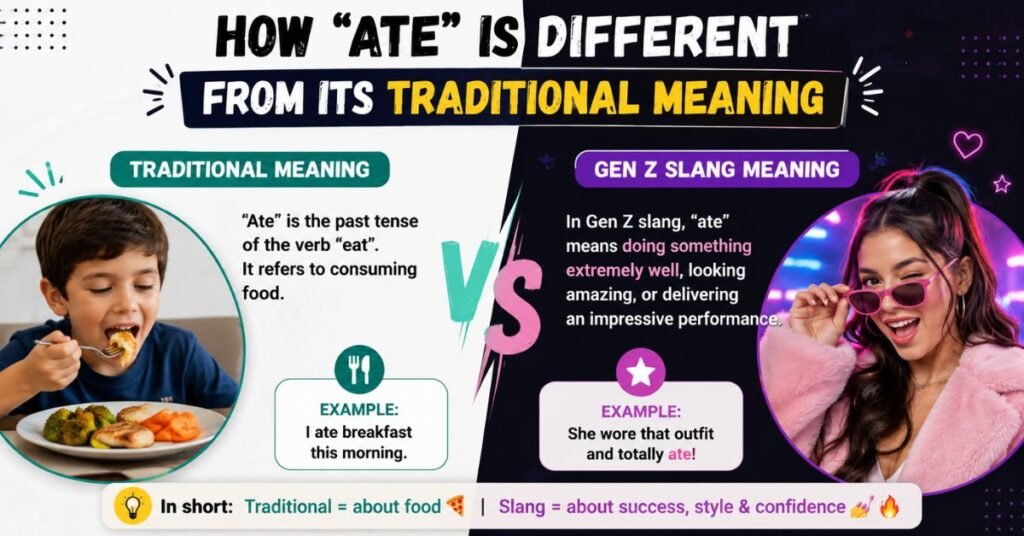
Normally, “ate” is just the past tense of “eat.” You ate breakfast. He ate the last slice of pizza. Nothing complicated about it.
In slang, the word gets completely repurposed. There’s no food involved at all. Instead, “ate” becomes a compliment about performance, style, or execution. The connection makes a bit more sense once you think about the phrase “she served and ate” like someone cooked up something amazing and consumed it themselves, meaning they crushed it so hard even they can appreciate it.
This is a good example of how slang works in general. Words get borrowed, twisted, and reused in ways that have nothing to do with the dictionary definition. If you only know the traditional meaning, a sentence like “he really ate that outfit” is going to sound like nonsense. Once you know the slang version of the ate slang meaning, it clicks instantly.
How “Ate” Is Used in Different Contexts
The ate slang meaning doesn’t stay exactly the same everywhere. The core idea doing something impressively stays consistent, but the specific context shifts depending on where and how it’s used.
Fashion, Beauty, and Style
This is probably where “ate” gets used the most. If someone posts an outfit photo, a makeup look, or a hair transformation and it looks flawless, expect the comments to be full of “she ate,” “this ate,” or just “ATE” in all caps. It’s shorthand for “you look incredible” or “this look is perfect.”
Music, Dance, and Performances
“Ate” shows up constantly under dance covers, singing clips, and live performance videos. If a dancer nails a difficult routine or a singer hits a note perfectly, people will comment “he ate that” or “they ate this performance.” It signals that the skill level was clearly above average.
Social Media and Online Posts
Beyond looks and performances, “ate” also gets used more loosely for tweets, captions, memes, or even a really good comeback in an argument. If someone posts something clever, witty, or just objectively correct, people might reply “you ate with this one.” The ate meaning on social media has basically expanded to cover any moment someone did something well, not just physical performance.
This is what makes the ate slang meaning so flexible compared to a lot of other Gen Z slang terms. It’s not locked into one type of content. A debate reply, a fit check, a dance video, and a viral tweet can all get the same one-word verdict, and everyone reading it instantly understands what’s being praised.
What Does “Ate and Left No Crumbs” Mean?
This is the full, extended version of the phrase, and honestly it’s more common than “ate” on its own in a lot of comment sections. Ate and left no crumbs means someone didn’t just do well they did so well that there’s nothing left to criticize. No flaws. No mistakes. Total perfection, top to bottom.
Think of it like this: if “ate” means someone finished the meal, “left no crumbs” means they cleaned the plate completely. There’s no evidence anything went wrong. It’s the internet’s way of saying “flawless victory.”
You’ll see this phrase used for outfits, performances, comebacks, debates, and even physical transformations. It’s basically the upgraded, more dramatic version of just saying “ate.”
If the standard ate slang meaning is a solid compliment, “left no crumbs” is the version reserved for the moments that actually stop people mid-scroll. It’s not used for every good outfit or decent cover it’s saved for the ones people can’t stop talking about.
How to Use “Ate” in a Sentence
Using “ate” correctly is easier than it looks once you get the rhythm of it. It usually goes right after the subject, almost like a mini verdict on what just happened. You don’t need a long sentence; sometimes one word does the whole job.
Getting comfortable with the ate slang meaning in a sentence is mostly about tone. Say it like you’re genuinely impressed, and it’ll land the right way almost every time.
See Also: MLM Meaning Slang:12 Surprising Things You Should Know
Here are some real examples of how people actually use it:
- She ate that performance.
- He really ate with this outfit.
- Not gonna lie, you ate.
- This whole video? Ate.
- They ate and left no crumbs with that choreography.
- I can’t believe how much she ate in that interview.
- Bro ate with that comeback, no cap.
- Ate.
- The way she ate this look is unreal.
- He ate that solo, hands down.
- You ate, and everyone in the comments agrees.
- This cover ate so hard I replayed it three times.
- She ate the runway walk like it was nothing.
- Ngl, that reply ate.
Notice how some are just one or two words, and others stretch out into full sentences. That mix is normal. Slang doesn’t need to follow a fixed pattern to make sense.
Real-Life Examples of “Ate” Slang
To make this even clearer, here’s how “ate” plays out in real conversations you’d actually see online or over text.
- Comment on a dance video: “the way she ate this choreo omg”
- Text between friends: “did you see her prom dress?? she ATE”
- Reply to a viral tweet: “this one ate no lies detected”
- Comment on a cover song: “he ate this cover, better than the original ngl”
- Group chat message: “bro ate that interview answer, straight facts”
- Comment on a makeup transformation: “this glow up ate and left NO crumbs”
- Text reacting to a friend’s outfit pic: “you ate today what is this fit”
These examples show how flexible the word is. It works in texts, comments, captions, and casual talk between friends without needing much explanation once you’re familiar with it. Once the ate slang meaning clicks for you, spotting it in the wild becomes second nature.
Ate vs. Similar Gen Z Slang
A lot of Gen Z compliments sound similar on the surface, but they carry slightly different shades of meaning. Here’s how the ate slang meaning stacks up against the closest alternatives.
Ate vs. Slayed
| Term | Meaning/Context |
| Ate | Did something impressively well, often tied to looks, performance, or skill |
| Slayed | Did something with confidence and style, often used for outfits or bold moves |
Both are compliments, but “slayed” leans more toward confidence and boldness, while “ate” leans more toward flawless execution.
Ate vs. Served
| Term | Meaning/Context |
| Ate | The result — someone crushed it, no flaws |
| Served | The action — someone delivered a strong look or performance |
“Served” and “ate” are often used together, like “she served and ate,” because they describe two parts of the same moment: the delivery and the outcome.
Ate vs. Killed It
| Term | Meaning/Context |
| Ate | Internet slang, rooted in ballroom and AAVE culture, casual and trendy |
| Killed It | Older, more universal English phrase, works in both formal and casual settings |
“Killed it” is safe to use pretty much anywhere, even in a work setting. “Ate” is strictly casual internet slang and would sound out of place in anything formal. Keeping the ate slang meaning separate from more formal compliments helps you avoid sounding out of place in the wrong setting.
Related Gen Z Slang Terms
If the ate slang meaning is new to you, there’s a good chance these related terms will pop up around it too. Here’s a quick rundown:
See Also: Snatched Meaning Slang: 10 Powerful Meanings & Uses
- Slayed – did something with confidence and style
- Served – delivered a strong look or performance
- No crumbs left – did something so well there’s nothing to criticize
- Understood the assignment – did exactly what was needed, and did it well
- It’s giving… – used to describe the vibe or energy of something
- Rizz – charisma, especially in a romantic or flirty context
- Mid – average, unimpressive, the opposite energy of “ate”
- Iconic – memorable, standout, worth remembering
When Should You Avoid Using “Ate”?
The ate slang meaning is fun and expressive, but it’s not the right fit for every situation. Here’s when to hold off:
- Don’t use it in formal writing, emails, or school assignments it reads as too casual.
- Skip it in professional settings like job interviews or workplace messages.
- Avoid using it with people who clearly aren’t familiar with internet slang, since it can come across confusing rather than complimentary.
- Be careful using it sarcastically online, since tone doesn’t always translate well in text and it could be misread as genuine praise.
- Don’t overuse it in every single comment it loses its impact if it’s attached to everything.
- Skip it when talking about actual food or eating, since the context will get confusing fast.
- Don’t force the ate slang meaning into a sentence where a simple “great job” would sound more natural.
Frequently Asked Questions
What does “ate” mean in Gen Z slang?
The ate slang meaning in Gen Z slang is simple: someone did something extremely well, whether that’s a performance, an outfit, or just a clever comment. It’s a compliment, not a literal reference to eating.
What does “ate” mean on TikTok?
On TikTok, “ate” usually shows up in comments under videos where someone looked amazing or performed impressively. The late meaning on TikTok is basically shorthand for “you did that.”
What does ate mean in Gen Z?
In Gen Z slang, “ate” means someone did something extremely well, looked amazing, or delivered an impressive performance.
It’s usually a positive compliment, similar to “you nailed it” or “you killed it.”
What does “I ate” mean in slang?
“I ate” means “I did really well” or “I absolutely nailed it.”
It can describe succeeding at something, looking great, or giving an impressive performance.
What does “ate” mean in slang LGBT?
In LGBTQ+ and online slang, “ate” is commonly used as praise when someone looks amazing or performs exceptionally well.
It is not exclusive to LGBT slang and is widely used across Gen Z and social media.
What does “he ate” mean in Urban Dictionary?
“He ate” means that a guy did something impressively well, such as delivering a great performance, outfit, comeback, or achievement.
It is generally a strong compliment meaning he “nailed it” or “did an amazing job.”
Final Thoughts
At the end of the day, the ate slang meaning comes down to one simple idea: recognizing when someone did something really, really well. It started in ballroom and AAVE culture, made its way through Black Twitter, and eventually became one of the most common compliments across TikTok, Instagram, and everyday texting.
Whether it’s an outfit, a performance, a comeback, or just a solid post, saying someone “ate” is a quick, punchy way to give credit where it’s due. Now that you know where it came from and how to use it, you’ll probably start noticing it everywhere and maybe even find yourself typing it under the next video that genuinely deserves it.

Arslan Rafi is a writer and language enthusiast who creates easy-to-understand content about slang, expressions, words, and their meanings. His work focuses on explaining regional and modern language in a clear, engaging way, helping readers understand how words and phrases are used in everyday conversation.