Research Dossier for Target Company: Complete Guide, Free Template & AI Workflow (2026)
Introduction
Picture this. A supplier sends you a polished proposal. The website looks sharp and the price feels fair. Then you search the company name in the state registry and find nothing. Maybe it’s a trade name. Maybe it’s a different legal entity. Maybe it’s trouble. You can’t tell yet, and that gap is exactly why a research dossier for target company work exists.
A company research dossier pulls sourced facts about one business into one document. It supports one decision. You’ll get a 12-section framework, a map of public record sources, a nine-step process, an AI workflow, a free template and a real example. The word “target” only means the subject of your target company research. It has nothing to do with Target Corporation. Nothing here counts as legal or financial advice.
What Is a Research Dossier for a Target Company?
A target company research dossier is a dated file about one business. It lists what you can prove about its identity, leaders, products, money and risks. Every fact carries a source and a date. Bad news stays in. Gaps stay visible too. Think of it as a business research report built for a single choice.
Other documents look similar but do different jobs. A company profile research note describes a business in a light way. Business due diligence digs far deeper for a deal. A sales battlecard helps reps win against rivals. The table below shows the gap.
| Document type | Main purpose | Depth | Typical users |
| Research dossier | Support one decision | Medium to deep | Sales teams, recruiters, analysts, founders |
| Company profile | Describe a business | Light | Marketing and media teams |
| Due diligence | Examine a transaction | Deep | Lawyers, accountants, investors |
| Sales battlecard | Win competitive deals | Narrow | Sales reps |
Why Is a Research Dossier Important Before Making a Business Deal?
One bad vendor can cost you months. One fake partner can cost you money. A dossier catches many problems early. It forces you to check who you’re dealing with before you sign. That simple pause protects your budget and your name.
A solid file also gives you leverage. You walk into talks knowing the other side’s numbers, rivals and weak spots. You ask sharper questions. You spot claims that don’t match the record. This kind of business verification process turns a vague hunch into a clear position.
Benefits of Conducting Target Company Research
Speed is the first win. A good template means you stop starting from zero each time. You also make better calls because facts replace guesses. A clean corporate intelligence report lets your team agree on the same story. Meetings get shorter.
Risk shows up sooner as well. You see lawsuits, liens and complaints before they hurt. Your outreach improves too. A salesperson who knows a prospect’s hiring plans and product launches sounds smart. A founder who knows a partner’s debt load negotiates with confidence.
Who Needs a Company Research Dossier?
Almost anyone who makes choices about a business can use one. Sales teams use it to prepare calls. Recruiters and job seekers use it to judge an employer. Analysts and investors use it for screening. Buyers use it before they trust a new supplier. Even a small shop owner can use a short version.
Each user wants something different. The table matches the role to the goal.
| User | Main goal | Key focus |
| Sales rep | Win a meeting | Products, leaders, hiring signals |
| Job seeker | Judge an employer | Reputation, financial health |
| Buyer or procurement lead | Check a vendor | Legal status, ownership, complaints |
| Investor | Screen an opportunity | Financials, risks, leadership |
| Founder | Study a rival | Pricing, market, growth |
How Detailed Should Your Research Dossier Be?
Match the effort to the risk. A coffee chat with a prospect needs a quick scan. A supplier contract needs a deeper look. An acquisition needs professional review by lawyers and accountants. Spending ten hours on a cold call wastes time. Spending ten minutes on a merger invites disaster.
The table gives planning ranges. Treat the times as rough guides. Complex firms with global offices or long legal histories take longer. Use your first dossier for screening only. It never replaces expert corporate due diligence.
| Use case | Depth | Rough time |
| Sales call prep | Light | 15 to 30 minutes |
| Job interview | Light to medium | 30 to 60 minutes |
| Competitor study | Medium | 1 to 3 hours |
| Vendor or partner review | Medium to deep | 2 to 4 hours |
| Early investor screening | Deep | 3 to 5 hours |
| Acquisition | Professional review | Depends on the deal |
What Information Should a Target Company Research Dossier Include?
Twelve areas cover most needs. They run from legal identity to risks and a final recommendation. This company research checklist keeps you from missing key facts. It also keeps you from drowning in trivia. Pick the sections that fit your decision and skip the rest.
The table below shows each area and where to check it in the United States. Later sections explain how to dig into each one. Use the same order every time so your files stay easy to compare.
| # | Section | What to capture | Where to check |
| 1 | Identity and legal entity | Legal name, state, status | Secretary of State search |
| 2 | Ownership and structure | Parents, subsidiaries, investors | SEC filings, state records |
| 3 | Leadership and board | Names, roles, background | Proxy statements, official pages |
| 4 | Products and customers | What they sell and to whom | Website, annual reports |
| 5 | Business model and pricing | Revenue streams, pricing | Pricing pages, filings |
| 6 | Financial information | Revenue, profit, debt | SEC EDGAR, Form D |
| 7 | Market and competitors | Rivals, substitutes | Industry research |
| 8 | Hiring and growth signals | Open roles, expansion | Careers pages |
| 9 | Legal and regulatory matters | Lawsuits, liens | PACER, UCC records |
| 10 | Reputation | Reviews, complaints | CFPB, FTC, BBB |
| 11 | Digital footprint | Domain, official pages | Website, domain records |
| 12 | Risks and recommendation | Strengths, gaps, next steps | Your evidence log |
Company Overview and Business Background
Start with the legal company name, trade names and business registration details. Add the company headquarters, the business address and the state of formation. This company background research proves you have the right firm. Many companies share similar names.
Leadership Team and Key Decision-Makers
List the executive leadership, the board of directors and other key decision-makers. Note each person’s role and past jobs. Confirm names in proxy statements or official filings. This step is core to researching company executives.
Products, Services, and Business Model
Write down what the firm sells and who buys it. Then explain the business model. Does it earn from subscriptions, one-time sales or fees? Pricing pages and annual reports usually answer this.
Financial Performance and Revenue Information
Record revenue, profit, debt and funding. Label each number as confirmed, claimed or estimated. This forms your first company financial overview. Keep every figure tied to one reporting period.
Market Position and Industry Overview
Describe the market and the firm’s place in it. Note the industry classification and the main trends. Good industry research and analysis shows whether the whole sector grows or shrinks.
Competitors and Competitive Landscape
Name the three to five closest rivals. Add substitutes that solve the same problem. This forms the base of your competitor analysis. You’ll deepen it in a later section.
SWOT Analysis and Business Risks
Summarize the main strengths and weaknesses. Add outside threats and chances too. A short SWOT analysis helps you list potential business risks in one clear place.
Legal Status, Reputation, and Compliance
Check for lawsuits, liens and enforcement actions. Read complaints and news stories. This tells you about legal compliance and corporate reputation. A pattern matters more than a single odd case.
What Are the Best Sources for Target Company Research?
Go straight to the source. A government record beats a blog post. A filing beats a rumor. These are your primary information sources. They come from the body that created the record. Use them first.
Everything else is a secondary research source. News stories, reviews and funding sites help you find leads. They don’t replace the record. Public firms disclose a lot. Private firms disclose far less. The table shows where to look for each type.
| Question | Public company | Private company |
| What did it report? | SEC 10-K, 10-Q, 8-K | Public statements, if any |
| Does the entity exist? | State registry | State registry |
| Did it raise money? | SEC filings | SEC Form D, funding databases |
| Are there liens? | State UCC records | State UCC records |
| Are there federal lawsuits? | PACER | PACER and state courts |
| Are trademarks filed? | USPTO | USPTO |
| Any sanctions concern? | OFAC search | OFAC search |
Official Company Websites and Annual Reports
The official company website tells you how the firm wants to look. Read the About, Careers and Terms pages. Annual reports add more detail. Treat all of it as claims until a record backs it up.
SEC EDGAR and Public Financial Filings
The SEC EDGAR database holds public company filings for free. You’ll find annual reports, quarterly reports and event notices there. Form D filings also reveal some private fundraising.
US Government Business Information Sources
Many agencies publish useful data. Check USPTO trademarks, SAM.gov, USAspending.gov, OSHA, EPA ECHO and the OFAC sanctions search. Each one fills a different gap.
LinkedIn and Professional Networks
LinkedIn shows team size, job history and hiring moves. It’s a handy company information database for people. Remember that profiles are self-reported. Cross-check key titles elsewhere.
News Publications and Industry Reports
Good reporting spots events early. A market research report adds context on size and trends. Still, news points you toward records. It doesn’t prove a claim by itself.
External Primary Sources
Court files, trademark records and sanctions lists sit outside the company. That makes them strong. The PACER system charges $0.10 per page. A single document costs at most $3. Fees are waived if you stay at or under $30 in a quarter.
Global Company Registries for Worldwide Research
Your target may sit outside the United States. In the UK, search Companies House. For cross-border records, try OpenCorporates. The EU business registers portal links national registers across Europe.
How to Build a Research Dossier for a Target Company Step by Step
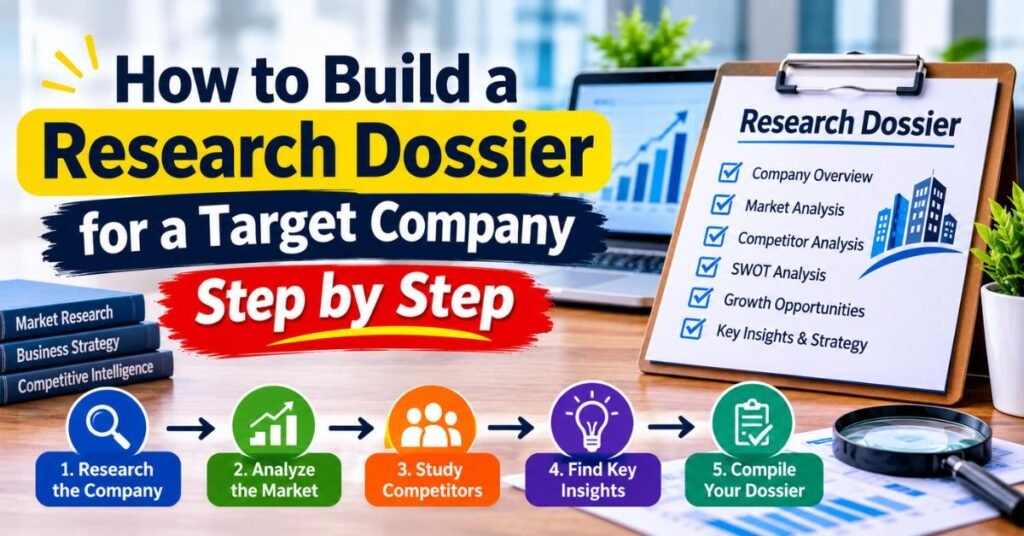
Nine steps turn scattered facts into a usable file. The target company research process begins with a clear question and ends with a review date. Follow the order. Skipping ahead often means redoing work later.
This section covers steps one to eight in detail. Step nine is simple. Set a date to review the file again. Update it sooner if leadership changes or a lawsuit appears. Healthy habits keep your business research methodology reliable over time.
Step 1: Define Your Research Objectives
Write your decision in one sentence. For example, “I need to decide whether this firm can be a reliable supplier.” That sentence tells you which facts matter. Everything else becomes noise.
Step 2: Identify and Verify the Company’s Official Website
Match the legal name in the footer to the state registry. Check that social profiles link back to the same domain. Watch for look-alike domains with swapped letters. A polished site is a starting point and never proof. This is how you learn how to verify company information.
Step 3: Collect Company Background Information
Gather the registered name, state, city, parent firm and founding date. For each source note the URL, title, publication date and the date you accessed it. Someone else should be able to repeat your search and get the same result. That’s the heart of target company information gathering.
Step 4: Research Leadership and Key Stakeholders
Look up the chief executive, the finance chief and the board. Read proxy statements for pay and background. Check for past failures or disputes. Compare names across at least two sources before you trust them.
Step 5: Analyze Financial Performance and Business Health
Pull the latest filings or reports. Study revenue, profit, cash and debt. Keep reporting periods lined up. Mixing years is one of the most common errors in analyzing a company’s financial health.
Step 6: Evaluate Competitors and Market Position
List the closest rivals and compare products, prices and customers. Note who leads and why. This shows whether your target wins or just survives. It also supports assessing company market position.
Step 7: Identify Potential Risks and Opportunities
Sort your findings into facts and opinions. Then list risks that could change your decision. Add any chances you spotted. This step is the core of identifying company risks and opportunities.
Step 8: Organize Findings and Document Reliable Sources
Build an evidence log and write a short summary. Start with your recommendation. Add the three most important facts and the three biggest unknowns. A reader who skips everything else should still grasp your view.
Which Financial Metrics Should You Analyze in a Target Company Dossier?
Numbers tell a story if you read them in the right order. A firm can show profit and still run out of cash. Another can lose money while growing fast. That’s why one metric never tells the whole tale. Solid financial company analysis uses several together.
Start with the annual financial statements. They include the income statement, the balance sheet and the cash flow statement. Public firms file them with the SEC. Private firms may share them only on request. The table gives quick checks for each metric.
See Also: FRABOC Explained: The Ultimate Guide to Meaning, History & Cancer Risk Assessment (2026)
| Metric | Simple formula | Quick sanity check |
| Revenue growth | (This year − last year) ÷ last year | Does it beat the industry? |
| Net profit margin | Net income ÷ revenue | Is it steady across years? |
| Current ratio | Current assets ÷ current liabilities | Above 1 means short-term bills are covered |
| Debt to equity | Total debt ÷ shareholder equity | Is debt rising faster than profit? |
Revenue and Revenue Growth
Revenue growth shows demand. Compare this year to last year and to rivals. Fast growth can hide weak margins. Slow growth can signal a mature but stable firm.
Profit Margins and Net Income
The net profit margin shows how much of each dollar the firm keeps. Check the income statement for one-time gains or losses. They can distort net income in a single year.
Cash Flow and Liquidity
Cash flow analysis reveals whether the firm can pay its bills. Strong operating cash flow is a good sign. Negative cash flow with no funding plan is a warning.
Assets, Liabilities, and Debt
The balance sheet lists what the firm owns and owes. Look at debt levels and due dates. Heavy short-term debt with little cash can spell trouble.
Financial Stability and Growth Potential
Blend all the numbers into one view of evaluating business performance. Ask whether the firm can survive a bad year. For public firms, also check market capitalization, which equals share price times shares outstanding.
How Does Competitive Intelligence Improve Company Research?
A company only makes sense next to its rivals. A 10% growth rate sounds great until you learn the market grows 30%. Competitive intelligence analysis adds that missing context. It shows where your target stands and where it’s heading.
Good work here supports analyzing industry competition with real facts. You’ll learn who wins deals and why. You’ll also see where gaps exist. That knowledge helps in sales, partnerships and negotiations alike.
Identifying Direct and Indirect Competitors
Direct rivals sell the same thing to the same buyers. Indirect rivals solve the same problem in a different way. Map both groups. A taxi firm competes with ride apps and with buses.
Comparing Products, Services, and Pricing
Build a simple side-by-side chart. Compare features, plans and price points. Look at reviews to see what customers love or hate. Note any clear gaps.
Evaluating Market Share and Competitive Advantages
Estimate who holds how much of the market. Then note what protects each firm, such as brand, patents or low costs. This gives you a clear view of market positioning.
Identifying Industry Trends and Market Opportunities
Watch for shifts in rules, tech and buyer habits. A trend can lift or sink a firm. Spotting it early reveals fresh business opportunities for you.
How to Perform a SWOT Analysis for a Target Company
A SWOT analysis sorts what you learned into four boxes. Two look inward. Two look outward. Keep it short and honest. Only list items your evidence log supports. Opinions without proof belong elsewhere.
The goal isn’t a pretty chart. It’s a clear view of strengths and weaknesses next to chances and threats. This kind of target company analysis helps you decide quickly. It also gives you talking points for negotiations.
Strengths and Competitive Advantages
List what the firm does well. Think strong brands, loyal customers, patents or low costs. Back each point with a source.
Weaknesses and Internal Challenges
List what holds the firm back. Examples include heavy debt, high staff turnover or one big customer. Internal gaps often hide in the notes of financial filings.
Opportunities for Business Growth
List openings the firm could use. A new market, a new product or a friendly rule change might help. Say whether the firm seems ready to act.
Threats and External Risks
List outside forces that could hurt. New rivals, tough regulations and supply shocks all count. This feeds your company risk assessment.
How to Verify and Validate Information in Your Research Dossier
Trust, but check. Every claim in your file needs a label. Use Confirmed, Company claim, Estimate or Unverified. Add a grade for the source too. This data verification habit keeps your report honest and easy to defend.
An evidence log ties each claim to its record. Grade A means a direct primary source such as a government filing. Grade B means a trusted secondary source. Grade C means weak or self-reported evidence. The grade rates the source and not the conclusion.
| Claim | Source | Date | Label | Grade |
| FY2026 revenue was $331.8 billion | Microsoft earnings release | FY ended June 30, 2026 | Confirmed | A |
| FY2026 operating income was $155.2 billion | Microsoft earnings release | FY ended June 30, 2026 | Confirmed | A |
| Results were released July 29, 2026 | Microsoft 8-K filing | July 29, 2026 | Confirmed | A |
Cross-Checking Multiple Information Sources
Never rely on one source. Compare at least two. If they disagree, trace both back to the original record. The older or more official one usually wins.
Confirming Company Registration and Legal Details
Search the state or national registry for the legal name. Confirm the status is active. This is the best way of verifying company ownership and registration before you share money or data.
Verifying Financial Data and Business Claims
Compare every figure with the original filing. Check the period and the currency. A claim like “we grew 300%” needs a base number to mean anything.
Checking Website Authenticity and Online Reputation
Look at the domain age and contact details. Read independent reviews and complaint sites. Strange changes in names or phone numbers across pages deserve a closer look.
Distinguishing Verified Facts From Assumptions
Keep facts and guesses in separate columns. Mark every guess clearly. Also remember that “no results found” never means “no problem.”
How to Use AI to Create a Research Dossier for a Target Company
AI-powered company research saves hours. It sorts notes, suggests sources and drafts summaries. It also makes mistakes. It can mix up two firms with similar names. It can invent a citation that doesn’t exist. So treat AI as a fast assistant and never as a source.
Use a four-stage workflow. First, scope the task and confirm the exact firm. Second, collect leads with AI help. Third, open each source yourself and check it. Fourth, ask AI to summarize only the verified material. Then edit the final words yourself.
See Also: Deshoptec Com Review 2026: Amazing Features, Benefits & Complete Guide
Best AI Tools for Company Research
ChatGPT, Claude, Gemini and Perplexity can all search the web and summarize pages. These are popular AI tools for company research. Features and prices change often. Check each vendor’s official page before you pay.
Step-by-Step AI Research Workflow
Give the AI the legal name, domain and state. Ask for findings with direct URLs and dates. Then open every link. Delete or relabel anything you can’t confirm. Log who reviewed each change.
Copy-and-Paste AI Prompt for Building a Company Dossier
Fill in the brackets and paste this prompt into your AI tool.
How to Fact-Check AI-Generated Research
Open every cited link. Make sure the page supports the exact claim. Compare numbers with the original document. Match the company name against the registry. Watch the dates closely.
Common AI Research Limitations and Mistakes
AI often picks the wrong entity. It may use old data or mix reporting periods. It can also sound sure when it’s wrong. The fix is simple. Verify before you trust.
What Common Mistakes Should You Avoid When Building a Company Dossier?
Most errors come from haste. People grab the first result and move on. They trust a slick website. They forget to date their notes. A few simple habits prevent nearly all of these slips.
Mistakes also hide in scope. Some people gather too little. Others collect everything and bury the key facts. Aim for the facts that serve your decision. A short, accurate file beats a long, messy one.
Relying on Outdated or Unverified Information
Old data misleads. A firm may have new owners or a new name. Always check the date of each source. Refresh key facts before a big decision.
Ignoring Financial and Legal Red Flags
Watch for a legal name that conflicts with the registry. Watch for repeated lawsuits or a pile of unresolved complaints. A red flag isn’t proof of fraud. It’s a reason to dig deeper.
Overlooking Competitors and Market Conditions
A firm in a shrinking market faces extra pressure. A firm facing a giant rival faces it too. Skipping this view leaves a hole in your strategic company assessment.
Confusing Assumptions With Verified Facts
Guesses sneak into files easily. Label them or cut them. If you can’t point to a source, call it Unverified.
Collecting Too Much Irrelevant Information
More data isn’t better data. Return to your one-sentence decision. If a fact doesn’t help, leave it out.
How Long Does It Take to Build a Target Company Research Dossier?
Time depends on depth and complexity. A light scan takes under an hour. A vendor review can take a half day. Public firms are faster because filings are easy to find. Private firms take longer because data is scarce.
Experience speeds things up too. A good template and a clear prompt cut hours from the job. Track your own times on your first few files. You’ll soon know how long each step really takes.
| Task | Manual time | With a template and AI help |
| Quick profile | 30 to 60 minutes | 15 to 30 minutes |
| Vendor review | 3 to 4 hours | 2 to 3 hours |
| Deep screening | 5 or more hours | 3 to 4 hours |
What Are the Best Tools and Platforms for Company Research?
Many tools exist. Free government sites cover the basics. Paid platforms add speed and extra data. Pick tools that match your budget and your decision. Use business intelligence tools to save time but still check the original record.
Remember that a platform’s estimates aren’t official records. Coverage and pricing change by provider and plan. Always check the vendor’s own page before you rely on a price or a feature.
See Also: New Software DH58GOH9.7: Features, Benefits, Uses, and Complete Guide
Financial Research and Business Intelligence Tools
Platforms like Crunchbase, PitchBook and ZoomInfo cover funding, contacts and market data. They support business intelligence research at scale. Expect a cost and some gaps in coverage.
Company Verification and Public Records Databases
State registries, SEC EDGAR, USPTO and court systems are the core. Most are free. Some records cost money. These sources power your business verification process.
Competitor Analysis and Market Research Tools
Traffic tools, review sites and industry reports show how rivals perform. They also reveal pricing and customer mood. Use them to sharpen your company performance analysis.
AI-Powered Research and Productivity Platforms
AI assistants and note tools help you sort and summarize. Spreadsheets and docs keep your evidence log tidy. Pair them with human checks every time.
How to Turn Your Research Dossier Into an Actionable Business Strategy
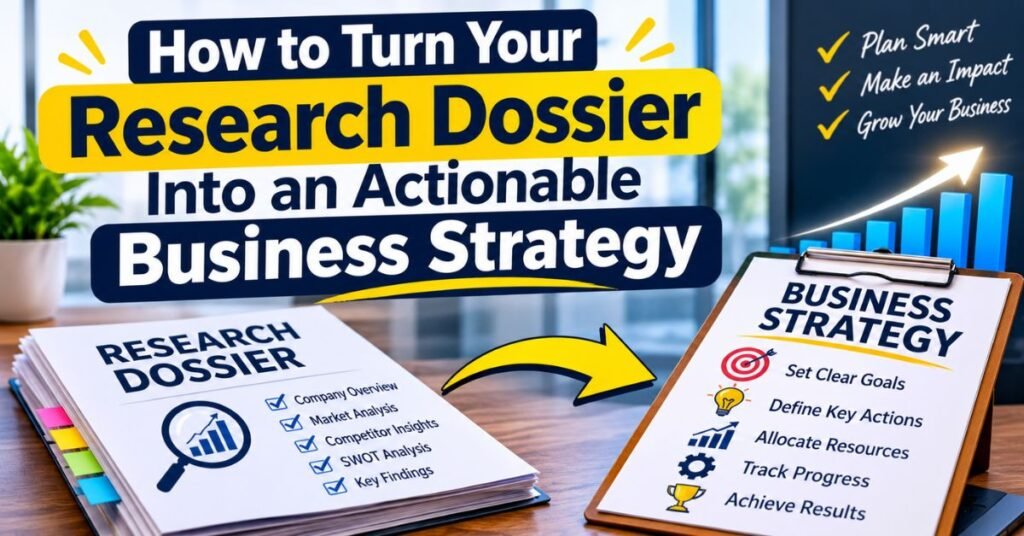
A dossier that sits in a folder helps nobody. Use it to act. Turn each finding into a next step. Ask what the file means for your price, your offer or your timing. That shift supports strategic business decision-making.
Share a one-page summary with your team. Keep the full log for anyone who wants proof. Different readers need different depth. A manager wants the verdict. An analyst wants the sources.
Using Research for Sales and Lead Generation
Use leadership news, hiring moves and product launches to personalize outreach. A message that mentions a real recent event gets read. A generic one gets ignored.
Preparing for Business Partnerships and Acquisitions
Check company ownership, debt and legal history before you commit. This is vital business partnership research. A careful target business evaluation also asks who really controls the firm. For mergers and acquisitions, a deeper business acquisition research effort comes next.
Supporting Investment and Due Diligence Decisions
Use the dossier as a screening step. It helps you decide who deserves a closer look. Full investment due diligence still needs professional advice. A dossier never replaces it.
Identifying Risks and Negotiation Opportunities
Weak margins, big debts or open lawsuits give you bargaining points. Use them fairly. Strong facts help you ask for better terms and preparing for business negotiations gets much easier.
Free Research Dossier Template for a Target Company
Build your own copy in a spreadsheet or doc. Start with the legal name, official site, purpose and review date. Add one row for each key claim. Finish with findings, open questions and a recommendation. Where a search finds nothing, write “Not found in the source checked” and add the date.
This free company research template works for any firm. It supports corporate profile development and repeat updates. Copy the layout below and adjust it to your goal.
| Field | What to enter |
| Legal name and domain | Registry name and confirmed website |
| Purpose and decision | One sentence |
| Claim | The fact you want to prove |
| Source URL | Direct link to the record |
| Publication date and access date | Both dates |
| Label and grade | Confirmed, Company claim, Estimate or Unverified, plus A, B or C |
| Summary and recommendation | Top three facts, top three unknowns |
Essential Sections to Include in Your Template
Include all 12 sections from earlier. Add a source log, a SWOT box and a review date. Keep the layout the same for every company. That makes files easy to compare.
Example of a One-Page Company Research Summary
Open with your verdict in one sentence. Follow with three key facts and three open questions. Add a short risk note and the date. The whole page should fit on one screen.
How to Customize the Template for Your Business Goals
Sales teams can add a buyer map. Procurement teams can add a legal check column. Investors can add valuation notes. Remove any section that doesn’t serve your decision.
Worked Example: Researching a Target Company in the United States
This case study uses Microsoft Corporation. It’s a public firm with easy-to-find filings. Microsoft’s investor relations page and its 8-K filing on SEC EDGAR supply the numbers. The example is for learning only. It isn’t advice to buy, sell or hold any security.
The table below shows the key findings. It also works as a small company investigation report sample.
| Item | Finding | Source |
| Legal identity | Microsoft Corporation, Washington incorporation, June 30 fiscal year-end | SEC filing record |
| FY2026 revenue | $331.8 billion, up 18% | Earnings release, July 29, 2026 |
| FY2026 operating income | $155.2 billion, up 21% | Earnings release, July 29, 2026 |
| Leadership | Satya Nadella, chairman and CEO; Amy Hood, CFO | Microsoft release |
| Legal matters and risks | Not assessed in this example | Needs separate record searches |
Company Overview and Background
Microsoft makes software, cloud services and devices. The SEC lists it as a reporting company. Its fiscal year ends June 30. That date matters because every figure must match the same period.
Financial and Competitive Analysis
For the fiscal year ended June 30, 2026, revenue reached $331.8 billion and operating income hit $155.2 billion. That gives an operating margin near 47%. Net income was about $133.7 billion, so the net margin sits near 40%. Net income also included gains from OpenAI investments, which flatter the total. Microsoft Cloud revenue grew 27% to $214.4 billion, per the proxy statement. Microsoft has since reported results for the quarter ended September 30, 2026.
Key Findings and Potential Red Flags
Revenue and profit traced straight to Microsoft’s own release. That earns a Grade A. Yet the example didn’t search court records, liens or sanctions lists. So a claim like “Microsoft has no legal problems” can’t be made. Good dossiers admit what they didn’t check.
Lessons From the Research Example
Primary sources beat summaries. Matching reporting periods prevents errors. Stating limits builds trust. A short, honest file serves a reader better than a long, vague one.
Legal and Ethical Considerations When Researching a Company
Use only lawfully available information. Read each site’s terms before you collect or reuse data. Some sites ban automated scraping. Follow the privacy rules that apply to you. Europe’s GDPR, for example, limits how you handle personal data.
Researching people for hiring, credit or other regulated choices can trigger extra rules in many countries. Talk to a qualified lawyer before you rely on a dossier for those uses. This content is educational and isn’t legal advice.
Frequently Asked Questions
Quick answers appear below. Each one links back to a deeper section above. Use them as a fast refresher.
These answers suit most readers worldwide. Local rules and registries differ by country. Always check the official source for your region.
What Is a Research Dossier for a Target Company?
It’s a dated report that collects sourced facts about one company to support one decision. It covers identity, ownership, leaders, products, finances, rivals, reputation and risks.
What Should a Company Research Dossier Include?
It should cover twelve areas: identity, ownership, leadership, products, business model, finances, competitors, hiring signals, legal matters, reputation, digital footprint and risks. Add an evidence log for key claims.
How Do I Research a Private Company in the United States?
Start with the Secretary of State registry and the official website. Then check SEC Form D filings, UCC records, court records and USPTO data. Private company research yields less data, so label gaps and estimates clearly.
Where Can I Find Free Company Information in the US?
Try SEC EDGAR, state registries, USPTO, SAM.gov, USAspending.gov, OSHA, EPA ECHO and OFAC. The CFPB and FTC share complaint and enforcement data. Most are free, though some records cost money.
Can ChatGPT, Claude, or Gemini Create a Company Research Dossier?
They can organize notes, suggest sources and draft summaries. They can also err or invent citations. Ask for direct URLs and dates. Then check each claim against the original.
How Can I Verify a Company’s Official Website?
Compare its legal name with the registry. Check contact details and social links. Read the About, Careers, Privacy and Terms pages for matching names. Look closely at look-alike domains.
What Is the Difference Between a Company Profile and a Research Dossier?
A profile describes a business in broad strokes. A dossier supports a decision with dated sources, labels, risks and gaps.
How Often Should You Update a Company Research Dossier?
Review it before any major decision. Update it after a leadership change, a lawsuit or new financial results. For active deals, check it monthly.
Conclusion:
A great dossier is sourced, dated and honest about gaps. Start with the decision. Lean on primary records. Let AI help you sort notes. Then check every key claim yourself. Grade your evidence and update the file when facts change.
Your next step is simple. Copy the 12-section structure. Pick one company. Build a one-page summary backed by an evidence log. Do it once and the second file takes half the time.

Arslan Rafi is a writer and language enthusiast who creates easy-to-understand content about slang, expressions, words, and their meanings. His work focuses on explaining regional and modern language in a clear, engaging way, helping readers understand how words and phrases are used in everyday conversation.