Why Does Ozdikenosis Kill You? The Truth About This Viral Disease Myth (2026 Guide)
Introduction: Why Is “Ozdikenosis” Trending Online?
You’ve probably seen the question why does Ozdikenosis kill you in your feed. It sounds scary and official. It also makes you want to click right away. That pull explains why the phrase spreads so fast. The question rests on a shaky base because no major health authority recognizes this illness. So is Ozdikenosis dangerous? Nothing proven says it is.
This guide covers the Ozdikenosis meaning and the Ozdikenosis disease myth. You’ll learn where the word may have come from and how viral disease searches grow. You’ll also pick up simple habits for spotting fake disease claims online. Along the way you’ll see how health misinformation hurts real people. Good digital health literacy starts with calm questions.
Is Ozdikenosis a Real Disease?
Here’s the direct answer. No. Is Ozdikenosis real? Not as a disease. Is Ozdikenosis a real medical condition? No major health body lists it. The World Health Organization keeps the International Classification of Diseases. You can check it yourself in the ICD browser. That’s disease verification in under a minute.
What does “not recognized” mean in practice? Doctors can’t diagnose it. Hospitals have no treatment plan for it. Researchers have no medical research to share. That’s Ozdikenosis disease explained in three lines. The Ozdikenosis death risk can’t even be measured because no verified condition exists to measure.
What You Need to Know About Ozdikenosis
What is Ozdikenosis? It’s a medical-sounding word with no clinical backing, and the table below sums up the Ozdikenosis medical facts at a glance.
| Question | Verified answer |
| Official disease status | Not recognized |
| Confirmed cause | None |
| Confirmed symptoms | None |
| Clinical studies | None found |
| Treatment guidelines | None |
Why Are People Searching “Why Does Ozdikenosis Kill You”?
Why are people searching for Ozdikenosis? Mostly curiosity and fear. A scary word grabs attention. A dramatic question like why does Ozdikenosis kill you feels urgent. People type it in before they think. Some also worry about Ozdikenosis health risks after seeing a vague video. That worry fuels more searching.
Can Ozdikenosis cause death? No evidence shows that it can. Yet the phrase “Ozdikenosis death” keeps getting typed because fear sticks. Many trending disease searches grow this way. One person asks. Others copy the question. Soon the Ozdikenosis viral search looks like proof that something real exists. It isn’t proof. It’s just a crowd repeating itself.
How Viral Disease Searches Spread Online
How do fake diseases spread online? They ride on autocomplete suggestions, trending lists, and short videos. Each one feeds the others. A video sparks a search, and the search sparks a suggestion. Then the suggestion sparks another video. The loop runs without any doctor in sight.
Where Did the Term Ozdikenosis Come From?
Where did the term Ozdikenosis originate? Nobody has shown a verified origin. No medical paper names it. No clinic reports it. The honest answer is “unknown.” Guessing a backstory would only add to the Ozdikenosis online rumors. What we can do is describe how made-up terms usually appear.
Invented terms often start in three ways. Someone glues random syllables together. Someone adds a scientific ending to a weird word. Or someone attaches a scary claim to a catchy label. Any of these can explain the Ozdikenosis causes of the buzz, though not of any illness. Content writers then repeat the term to chase clicks. That’s how Ozdikenosis misinformation takes root.
Why the Name Sounds Like a Real Medical Condition
The ending “-osis” appears in real words like fibrosis and scoliosis. Your brain sees the pattern and assumes the word is legit. That’s a mental shortcut. It’s not a fact check. Medical terminology gives a word instant authority, even when nothing stands behind it.
Why Do Fake Diseases Go Viral So Quickly?
Why do fake diseases become popular online? Emotion beats accuracy. A famous 2018 study in Science found that false news spread farther and faster than true news on social media. Health rumors follow the same pattern. Fear grabs people. Calm explanations don’t.
Four forces drive the spread, and the table shows how each one works.
| Driver | How it helps a rumor |
| Shock value | Strong feelings make people share fast |
| Short videos | Dramatic clips travel without context |
| Anonymity | Nobody has to prove a claim |
| Algorithms | Engagement gets rewarded over truth |
The Role of Social Media, Fear, and Curiosity
Social media health trends thrive on these three feelings. Imagine you’re scrolling late at night. A clip claims doctors hide a deadly illness. You feel a jolt of fear. Curiosity pushes you to search. Then you share the clip with a friend. Now the internet health rumors have two more carriers.
How to Recognize Unsupported Health Claims
How to identify fake health information takes three quick checks. Look for a named source first. Next, look for a real study. Finally, look for a quoted clinician. If all three are missing, treat the claim as misleading medical content.
Why Ozdikenosis May Seem Real Even Without Medical Evidence

Think of a fake movie trailer with a polished voiceover. It looks real, so you assume the film exists. Ozdikenosis health claims work the same way. The word has a clinical shape. The articles about it use serious tones. Your brain fills in the missing proof on its own.
Repetition also builds belief. Why do people believe viral medical rumors? Because hearing something often makes it feel true. After the fifth post, a rumor feels like common knowledge. This is how the Ozdikenosis disease myth gains weight without gaining any facts.
How Familiar Medical Language Can Create False Credibility
Long Latin-style words signal expertise. Readers see them and relax their guard. A word that looks scientific gets less doubt than a plain one. Good medical fact-checking means judging the evidence rather than the vocabulary.
The Psychology Behind Viral Disease Scares
Three mental traps explain most panic. Fear makes you picture the worst outcome. Confirmation bias makes you notice only posts that match your fear. Repeated exposure makes a claim feel proven. Together they power health anxiety.
Picture a simple headache. You search your symptoms. You land on a page about Ozdikenosis symptoms. Within seconds, a normal ache feels like a threat. That jump from “headache” to “deadly disease” happens fast. The table below shows each trap in action.
| Mental trap | What it does | Everyday example |
| Fear amplification | Pushes you toward worst-case thinking | A headache becomes a fatal illness |
| Confirmation bias | Filters out calm information | You only click scary pages |
| Availability bias | Treats repeated claims as true | You see the word daily and trust it |
How Fear and Uncertainty Influence Online Searches
Uncertainty makes people search more, especially at night or under stress. Not knowing feels worse than bad news. So you keep typing. Each new page feeds the worry instead of ending it.
How Search Engines and Content Farms Spread Health Misinformation
Ranking systems reward attention. Content farms know this. They copy trending keywords and publish quick articles. Many use automated writing to flood the web. That’s search engine misinformation in action. A rumor can look well-sourced when ten sites repeat it.
Source quality matters a lot here. Strong sources rely on scientific evidence and review. Weak ones rely on clicks. The table below ranks common source types.
See Also: Droven.io Cloud Computing Guide 2026: Features, Benefits, Setup, and Security
| Source type | Reliability | Typical behavior |
| Medical journals | Very high | Peer-reviewed research |
| WHO and CDC pages | Very high | Verified health data |
| Unknown health blogs | Medium to low | Mixed accuracy |
| Content farms | Very low | Keyword-driven fiction |
Warning Signs of Unreliable Medical Content
Watch for missing author credentials, no references, recycled text, and dramatic claims. One sign alone may be harmless. Several together mean you should leave the page. These habits support online rumor detection and medical misinformation online awareness.
Are There Any Real Symptoms of Ozdikenosis?
Are Ozdikenosis symptoms medically confirmed? No. Some pages list fatigue, headache, dizziness, and weakness. Those lists look convincing. But no clinical source backs them. You can’t build a clinical diagnosis from a copied list.
Why do these symptoms show up so often? They’re common and vague. Almost anyone has felt them this month. A fake disease page can borrow them and sound believable. That trick makes what are the confirmed symptoms of Ozdikenosis a question with a simple answer: none exist.
Why Unverified Symptom Lists Can Be Misleading
One symptom fits many real conditions. That’s why symptom checking on random pages fails. The table shows how broad common signs can be.
| Symptom | Common real causes |
| Fatigue | Anemia, stress, infections, poor sleep |
| Headache | Dehydration, migraine, tension |
| Dizziness | Blood pressure changes, anxiety |
What Actually Makes a Disease Life-Threatening?
What causes a disease to become life-threatening? Biology does the damage. A name doesn’t. That’s why Ozdikenosis kill you claims fall apart. No known process links the word to harm. The real question isn’t “why does Ozdikenosis kill you or is it a myth?” The real question is what harms the body in true life-threatening illnesses.
Real dangers include organ failure, severe infection, nerve damage, and out-of-control inflammation. Doctors rely on evidence-based medicine to spot and treat these. Many disease risk factors matter too, like age, existing conditions, and delayed care. A label alone never decides survival.
How Real Diseases Cause Serious Health Complications
Take sepsis. An infection spreads, and the body’s response begins damaging its own organs. The WHO sepsis fact sheet explains how serious this can become. That chain of events is a real medical fact. Nothing like it exists for this made-up term.
Real Medical Conditions That People May Confuse With Viral Disease Claims
Real illnesses can look like viral rumors. Flu-like infections cause tiredness and aches. Anxiety can cause a racing heart and dizziness. Autoimmune conditions and sleep disorders can cloud thinking. So your symptoms may be real even when the internet label is not. That’s why can Ozdikenosis cause serious health problems has a clear answer: only real conditions do.
Here’s the difference between real diseases and internet myths. Real diseases have diagnostic criteria, lab tests, and often imaging. Myths have blog posts, videos, and copy-pasted lists. Remember that contrast whenever an unfamiliar name appears.
Why Accurate Diagnosis Matters
A wrong label can delay the right care. It can also cause needless panic. A trained clinician looks at your history, exam, and tests. That process protects you in a way a search bar can’t.
The Dangers of Self-Diagnosing Based on Internet Searches
The risks of self-diagnosing from online searches are real. You might ignore a treatable problem. You might also panic over a harmless one. Normal body sensations start to feel alarming. Anxiety then makes those sensations louder. That’s a feedback loop of fear.
Picture this scenario. You feel tired. You search online. You find a page about Ozdikenosis health risks. You assume the worst. Your stress rises. Your tiredness gets worse. The loop closes and starts again. A calm visit to a doctor breaks it.
Why Online Symptom Checklists Cannot Confirm a Diagnosis
A checklist can’t examine you. It can’t order a blood test or ask follow-up questions. It only matches words. So treat it as a starting point for questions, never as a verdict.
How to Verify Whether a Disease Is Real
How can you verify a disease claim? Treat it like a quick skill. It takes a few minutes. Pause first. Then check trusted databases. Finally, compare what several credible sources say. How to check whether Ozdikenosis is a real disease follows the same steps as any other name. How to verify viral disease claims before believing them comes down to this habit.
The method supports medical misinformation prevention and builds health information accuracy in your own routine. Share it with friends and family. Small habits spread too.
Steps to Check Medical Claims Using Reliable Sources
Start with the WHO or CDC and search the exact name. Look for peer-reviewed studies next. Then compare definitions across sources. If the term appears nowhere reliable, the claim is probably fiction. This is what reliable medical sources say about Ozdikenosis: nothing, because they don’t list it.
Trusted Sources for Disease Information
Reliable sources for disease information include the World Health Organization, the CDC, MedlinePlus, and the NHS. These are trusted medical information websites and credible health sources. They offer verified disease information in plain language. Use them as trustworthy health resources whenever a strange name pops up.
Red Flags That a Viral Disease Claim May Be Fictional
Be wary of overdramatic names, “doctors hide this” claims, sudden popularity, and missing studies. Generic symptom lists are another warning. Two or more flags should make you stop and double-check.
Why Does Health Misinformation Spread Faster Than Facts?
How does health misinformation spread? Emotion travels quicker than nuance. The WHO infodemic page describes how too much information, both true and false, makes reliable guidance hard to find. People often share before they verify. That speed helps viral health rumors outrun corrections.
Platforms also reward engagement. Posts that shock earn more views than posts that explain. Automated writing adds even more volume. The result is a crowded web where online medical claims compete with careful research. Clicks often beat accuracy.
See Also: Thesindi.com Review: Technology, Business, AI, and Digital Knowledge
The Role of Emotional Headlines and Viral Content
Compare two headlines. One says, “Researchers find no evidence for a rumored illness.” The other says, “The deadly disease doctors won’t discuss.” The second wins clicks every time. Fear sells better than calm. Remember that when a headline makes your heart race.
Case Study: How an Unverified Disease Claim Can Go Viral
Here’s a hypothetical example, not a real event. A user posts that doctors won’t discuss a rare disease. Within days, blogs repeat the claim and short videos act out the symptoms. Search interest spikes. New articles appear to chase the traffic. Soon people ask why does Ozdikenosis kill you with no proof behind the question. This pattern shows how fake diseases spread online.
How to Protect Yourself From Online Health Misinformation
You don’t need medical training. You need a few habits. Pause before you believe a viral claim. Cross-check at least two reliable sources. Skip self-diagnosis from short videos. These steps build public health awareness and strengthen your digital health literacy. Over time, medical fact-checking becomes second nature.
Try a quick “before you share” test. Ask who wrote the claim. Ask what evidence supports it. Ask whether a trusted site confirms it. If you can’t answer, don’t share. This protects friends from fake disease claims online.
A Simple Rule for Checking Health Claims
If a claim sounds dramatic and hidden, double-check it before you trust it.
What Should You Do If You Feel Unwell?
When to seek professional medical advice is simpler than people think. Track your real symptoms. Note how long they last and how severe they feel. Then contact a doctor or your local health service early. Severe chest pain, trouble breathing, or sudden confusion needs emergency help right away. Skip the internet label and focus on your body.
What the Ozdikenosis Search Trend Teaches Us About Health Information
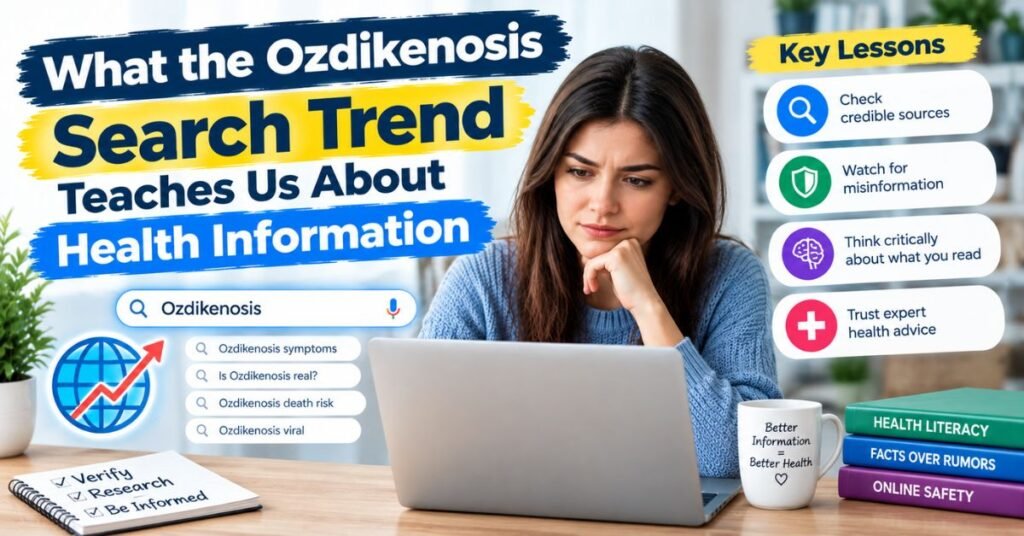
The big lesson is clear. Repetition can manufacture reality. A word with no evidence can look real after enough clicks. That’s true for Ozdikenosis misinformation and for many other internet health rumors. Notice the pattern and you’ll resist it.
Critical thinking is a health habit. It protects your mind as well as your body. Ask better questions. Prefer scientific evidence over loud posts. Trust sources that show their work. The same approach helps with what to do when an unfamiliar disease name appears online: pause, verify, and ask a professional.
Frequently Asked Questions About Ozdikenosis
These short answers cover the most common questions about the Ozdikenosis disease and the trend around it.
Is Ozdikenosis a Real Disease?
No. No major health authority recognizes it, and no clinical studies describe it. It works as an Ozdikenosis disease myth rather than a diagnosis.
Why Do People Search “Why Does Ozdikenosis Kill You”?
Curiosity and fear drive the searches. Viral posts and copied articles keep the loop running, so the phrase keeps trending.
Are There Verified Symptoms of Ozdikenosis?
No. Any list you find online is generic and unsupported. Those signs belong to many real conditions instead.
Why Does the Name Ozdikenosis Sound Medical?
It borrows the “-osis” ending from real medical terms. That pattern tricks your brain into assuming the word is legitimate.
What Should I Do If I Have Serious Symptoms?
See a doctor or local health service. Describe what you feel in plain words. Skip any internet label and let a professional examine you.
How Can I Avoid Health Misinformation Online?
Check claims on trusted sources like the WHO and CDC first. Pause before sharing. Look for studies, authors, and clear evidence.
Final Verdict:
No. It isn’t a recognized disease, so the question why does Ozdikenosis kill you has no medical answer. The Ozdikenosis death risk is zero in any verified sense because no verified illness exists. The real risk comes from fear, health misinformation, and poor sources.
Take one clear action. Verify before you worry. If you feel unwell, talk to a qualified professional about your real symptoms. That choice protects your health far better than any viral search.

Arslan Rafi is a writer and language enthusiast who creates easy-to-understand content about slang, expressions, words, and their meanings. His work focuses on explaining regional and modern language in a clear, engaging way, helping readers understand how words and phrases are used in everyday conversation.